
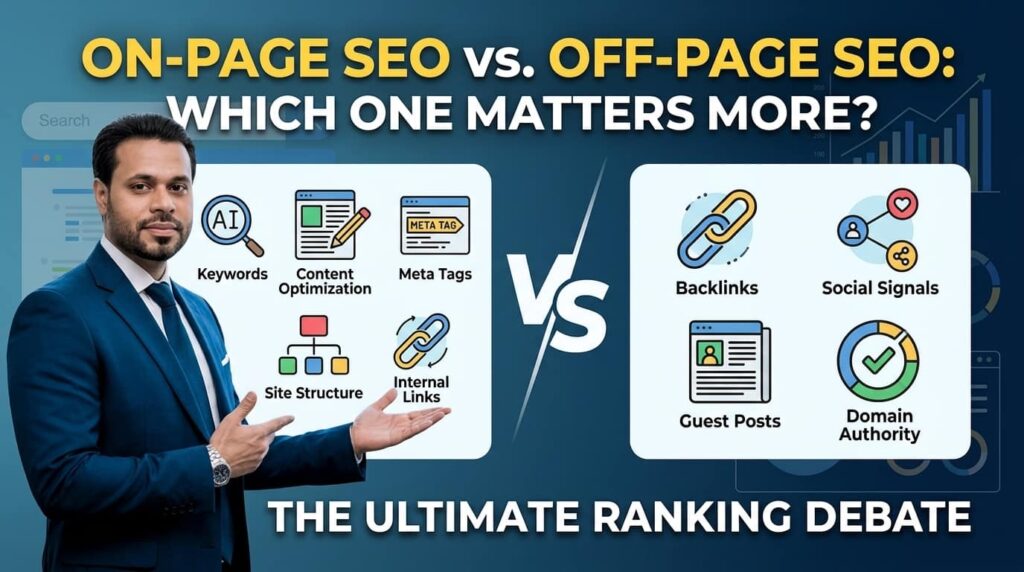
On-Page SEO vs Off-Page SEO: Which One Matters More for Rankings?
Two sides of the same coin — but Pakistani websites consistently over-invest in one and neglect the other. This guide explains where each delivers ranking impact and how to balance both correctly.
On-Page SEO vs Off-Page SEO: On-page SEO covers everything you control directly on your website — content quality, keyword placement, title tags, meta descriptions, internal linking, schema markup, and page speed. Off-page SEO covers external signals, primarily backlinks from other authoritative websites, that indicate your site’s credibility and authority to Google. Both are required for competitive rankings. On-page is the foundation; off-page is the amplifier.
Every Pakistani website that is not ranking where it should be has a problem in one of these two areas — or both. The classic diagnostic question is: does this site have a content and technical problem (on-page) or an authority and backlinks problem (off-page)? After auditing hundreds of Pakistani websites across every major industry, Junaid Tariq’s SEO consulting practice finds that most Pakistani businesses have significant on-page deficiencies that must be fixed before off-page investment produces meaningful results. Building backlinks to a technically broken, thin-content website is like advertising a product that has not been manufactured yet.
On-Page SEO: Everything You Control on Your Own Website
On-page SEO is the comprehensive discipline of optimising the content and technical elements within your website to communicate relevance and quality to Google’s search systems. It begins with keyword research and content strategy — identifying what Pakistani searchers are looking for and creating content that fully satisfies those queries. It extends through title tag and meta description optimisation (the copy that appears in search results), header hierarchy (H1, H2, H3 structure), internal linking (directing Google’s crawl and distributing page authority across your site), schema markup (structured data that helps Google understand your content type and entities), and page speed and Core Web Vitals compliance.
On-page SEO is entirely within your control. You decide the content quality, the keyword targeting, the technical implementation, and the user experience. This controllability makes on-page the logical starting point for any SEO engagement — you fix what you own before spending resources trying to acquire external signals. A Pakistani e-commerce website with 5,000 product pages that have duplicate descriptions, missing title tags, and slow load times will not benefit from a link building campaign until those on-page issues are resolved.
Off-Page SEO: External Authority Signals That Google Trusts
Off-page SEO refers to all ranking signals that exist outside your website itself. The most important and most consistently influential off-page signal is backlinks — links from other websites pointing to your content. When an authoritative website like Dawn.com, ProPakistani, or a respected international industry publication links to your Pakistani business website, Google interprets this as a vote of confidence in your content’s authority. The quantity, quality, and relevance of these inbound links remain one of Google’s most significant ranking factors.
Off-page SEO also encompasses brand mentions (citations of your brand name without a link), digital PR (earning coverage in authoritative publications), social signals (though Google has confirmed these are indirect rather than direct ranking factors), and Entity SEO — building Google’s Knowledge Graph understanding of your brand as a recognised entity in your field. For Pakistani businesses targeting competitive commercial keywords, off-page authority building is often the decisive differentiator between ranking on page one versus page two.
Control vs External: Why On-Page Must Come First
The most important sequencing rule in SEO: fix all on-page issues before investing significantly in off-page. Here is why. Backlinks pass authority from the linking site to your pages — but that authority can only translate into rankings if the receiving pages are properly optimised to rank for relevant keywords. If your page title says ‘Home – Our Company’ instead of ‘Accounting Services Lahore | Khan & Associates’, the backlinks pointing to it will not help you rank for accounting-related queries regardless of how many authoritative sites link to you.
Pakistani websites that invest in link building before addressing on-page fundamentals consistently underperform. The audit typically reveals: missing or duplicate title tags, no keyword intent alignment in content, poor internal linking that leaves important pages without sufficient authority flow, page speed scores below 50 on mobile, and no schema markup to help Google understand content type. Each of these on-page deficiencies reduces the conversion rate of off-page authority into actual ranking positions.
Content Optimisation: The On-Page Foundation That Cannot Be Skipped
Content quality and depth are the most significant on-page ranking factors in 2026. Google’s E-E-A-T framework evaluates Experience, Expertise, Authoritativeness, and Trustworthiness — all of which are signals that must be expressed through content. For Pakistani businesses, this means creating content that demonstrates genuine expertise in your industry, includes Pakistan-specific context and examples that generic international content does not offer, covers topics with sufficient depth to fully answer the searcher’s question, and is structured logically with clear H2/H3 hierarchy that makes it easy for both readers and Google to navigate.
Keyword integration within on-page content has evolved beyond simple keyword density. Modern on-page SEO requires semantic coverage of a topic — ensuring that your content includes not just the primary keyword but the related terms, entities, and questions that Google associates with the topic. For a Pakistani accounting firm, this means content that covers not just “accounting services Lahore” but also related entities like “tax filing Pakistan”, “FBR compliance”, “audit services”, and “corporate accounting Pakistan.” Our full-service SEO methodology includes comprehensive semantic keyword mapping for every client engagement.
Backlinks: Why Off-Page Authority Remains Essential for Competitive Rankings
Despite constant speculation about Google reducing backlink importance, links remain one of the most consistent ranking differentiators between competing pages with similar on-page quality. For competitive Pakistani commercial keywords — ‘real estate agency Karachi’, ‘IT outsourcing company Pakistan’, ‘best hospital Lahore’ — the pages that rank on page one of Google almost universally have significantly more authoritative backlinks than pages ranking on page two and beyond. On-page quality gets you competitive; off-page authority gets you to page one.
For Pakistani businesses, the most effective and sustainable off-page strategy combines: digital PR (getting coverage on reputable Pakistani news and industry sites), creating genuinely useful resources that Pakistani websites naturally link to (tools, research, guides with Pakistan-specific data), guest contributions to industry publications, and competitive backlink gap analysis (identifying which authoritative sites link to your competitors but not to you). Low-quality, paid backlink schemes from Pakistani link sellers remain prevalent — and remain dangerous, as Google’s Spam Brain system is increasingly effective at detecting and penalising manipulative link patterns.
Technical SEO: Where On-Page and Off-Page Meet
Technical SEO sits at the intersection of on-page and off-page work. Core Web Vitals (LCP, CLS, INP), mobile-first indexing compliance, crawl architecture, XML sitemaps, robots.txt configuration, and structured data markup are technically classified as on-page — they are implemented within your website. But their impact on rankings is significant enough that they effectively determine whether your off-page link authority can translate into page one rankings.
A Pakistani business website that loads in 8 seconds on mobile, has duplicate pages indexed, and lacks proper canonical tags is leaving ranking potential on the table regardless of its content quality or backlink profile. Google’s Core Web Vitals are now a confirmed ranking signal — page experience is factored into ranking position alongside relevance and authority. Ensuring technical SEO compliance is therefore a prerequisite for maximising the return on both on-page content investment and off-page link building.
Strategy Balance: How Junaid Determines the Right Ratio
The right balance between on-page and off-page SEO investment depends on three factors: (1) the current state of your website’s on-page quality, (2) the competitive backlink profiles of the top-ranking pages for your target keywords, and (3) your business timeline. With 18+ years of SEO consulting experience, the diagnostic approach is consistent: conduct a full on-page audit in month one, identify and implement on-page fixes in months 2–3, then begin systematic off-page authority building from month 3 onward while monitoring ranking response.
For most Pakistani businesses starting from a typical baseline — moderate on-page quality, minimal backlinks — the investment split in the first 12 months is approximately 60% on-page (content creation, technical fixes, internal linking) and 40% off-page (link acquisition, digital PR, brand mentions). As on-page quality matures, this shifts progressively toward more off-page investment to build the authority differential that separates page one from page two rankings. Book a free SEO audit with Junaid today to get a specific on-page vs off-page diagnosis for your Pakistan business website.
On-Page SEO vs Off-Page SEO: Complete Comparison
Factor |
On-Page SEO |
Off-Page SEO |
|---|---|---|
Location of Work |
Within your website |
External websites and signals |
Control Level |
100% within your control |
Dependent on third-party decisions |
Key Factors |
Content, titles, speed, schema |
Backlinks, brand mentions, PR |
Time to Impact |
Weeks (technical fixes) |
Months (authority building) |
Cost Structure |
Content + technical work |
Outreach + PR + content |
Foundation Required |
Yes — must come first |
Builds on on-page foundation |
Risk of Getting Wrong |
Rankings stagnate |
Algorithm penalties (bad links) |
Best Analogy |
Building a great product |
Marketing that great product |
Frequently Asked Questions
Which is more important — on-page or off-page SEO?
Both are essential, but on-page SEO must come first. Without proper on-page optimisation — correct keyword targeting, quality content, technical compliance, and good user experience — even the strongest backlink profile will underperform. Think of on-page as the foundation and off-page as the amplifier. For competitive Pakistani keywords, you typically need strong on-page quality (top 5% of comparable pages) AND meaningful off-page authority to consistently rank on page one.
Can I rank on Google with only on-page SEO and no backlinks?
Yes — for lower-competition keywords and local searches, strong on-page SEO alone can achieve page one rankings in Pakistan. Local searches like ‘accountant in Faisalabad’ or ‘plumber in Gulberg Lahore’ often have limited competition, meaning excellent on-page quality and a complete Google Business Profile can rank without significant backlinks. For competitive national and international keywords, backlinks become progressively more necessary as the competitive baseline rises.
How many backlinks do I need to rank in Pakistan?
There is no fixed number — what matters is the relative authority of your backlink profile compared to competing pages for the specific keyword you are targeting. For local Pakistani keywords, 10–30 quality backlinks from relevant Pakistani websites may be sufficient. For competitive national keywords like ‘SEO agency Pakistan’, you may need 100+ referring domains from authoritative sites to compete with established players. Use Ahrefs or SEMrush to analyse the exact backlink profiles of the pages currently ranking on page one for your target keywords.
What is the difference between on-page SEO and technical SEO?
Technical SEO is a subset of on-page SEO. On-page SEO encompasses everything within your website including content, keyword placement, and user experience. Technical SEO specifically covers the structural and performance aspects: page speed, Core Web Vitals, mobile optimisation, crawl architecture, schema markup, canonical tags, and indexability. For practical purposes, most SEO consultants treat technical SEO as a separate audit category — fix technical issues first, then optimise on-page content, then build off-page authority.
How long does off-page SEO take to improve rankings?
Off-page SEO typically takes 3–9 months to produce measurable ranking improvements, because Google evaluates new backlinks over time rather than immediately. High-quality backlinks from authoritative Pakistani domains (Dawn, ProPakistani, Tribune) produce ranking signals faster than generic backlinks. Consistent off-page work over 6–12 months typically produces the most significant ranking improvements for competitive keywords. Do not expect instant results — sustainable link building is a long-term authority investment.
Is link building still important for SEO in 2026?
Yes — link building remains one of the most significant ranking factors in 2026. Despite regular speculation about Google reducing link importance, the data consistently shows that backlink authority differentiates rankings for competitive queries. Google’s approach has shifted from counting all links equally to weighting link quality, relevance, and editorial context heavily. A single link from Dawn.com or ProPakistani is worth more than 100 links from low-quality Pakistani directory sites.
What are the most important on-page SEO factors for Google?
The most important on-page SEO factors for Pakistani websites in 2026: (1) Content quality and topical depth — comprehensive, genuinely helpful content that fully answers the searcher’s query; (2) Keyword alignment — correct primary keyword in title tag, H1, first 100 words, and naturally throughout; (3) Core Web Vitals compliance — LCP under 2.5 seconds, CLS under 0.1, INP under 200ms; (4) Mobile-first design — the majority of Pakistani Google searches are on mobile; (5) Schema markup — especially for local businesses, products, and FAQs; (6) Internal linking — connecting topically related pages to distribute authority and help Google understand site structure.
Can bad backlinks hurt my Pakistani website’s rankings?
Yes — manipulative, low-quality, or toxic backlinks can trigger Google Spam Brain penalties that suppress rankings significantly. Common sources of problematic backlinks for Pakistani websites: paid link schemes from local SEO vendors offering ‘guaranteed backlinks’, PBN (Private Blog Network) links, foreign-language spammy sites, and links from completely irrelevant industries. If your site has a history of questionable link building, a backlink audit using Ahrefs or Majestic followed by disavow file submission to Google Search Console is advisable before starting a clean link building campaign.
Ready to Build the Right Strategy for Your Business?
Junaid Tariq — Harvard & Google Certified | 18+ Years | $20M+ Managed | 500+ Clients | Direct Expert Access, No Junior Handoffs.