
Performance Marketing vs Digital Marketing: What Is the Difference and Which Do You Need?
Pakistani businesses are increasingly hearing ‘performance marketing’ — but most cannot clearly define how it differs from digital marketing. This guide settles the terminology and, more importantly, guides your budget allocation.
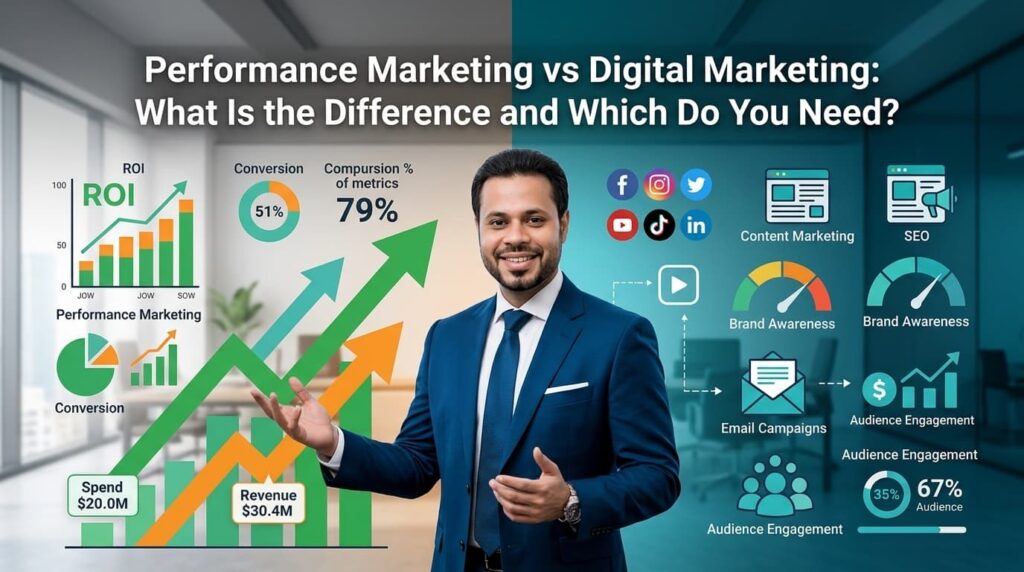
Performance Marketing vs Digital Marketing: Digital marketing is the umbrella term covering all marketing activities conducted through digital channels — including SEO, social media, email, content, and paid advertising. Performance marketing is a subset of digital marketing focused specifically on measurable, results-based campaigns where advertisers pay only when specific outcomes occur (clicks, leads, sales). All performance marketing is digital marketing, but not all digital marketing is performance marketing. Pakistani businesses need both — brand building through broad digital marketing, and revenue generation through performance marketing.
The terminology distinction between performance marketing and digital marketing creates genuine confusion for Pakistani business owners — and this confusion leads to strategic misallocation of budgets. Business owners who think all marketing should be “performance” end up cutting brand-building investment that creates the long-term demand their performance campaigns depend on. Business owners who dismiss “performance marketing” as jargon miss the accountability systems that maximise return on paid media spend. With 18+ years running both brand and performance campaigns for 500+ clients across 48 countries, Junaid Tariq’s framework for Pakistani businesses is clear: build brand through digital marketing, convert demand through performance marketing, and use SEO as the compound engine that reduces your dependence on both over time.
Defining Digital Marketing: The Full Spectrum
Digital marketing encompasses every marketing activity conducted through digital channels and platforms. It includes SEO (Search Engine Optimisation), content marketing, social media marketing, email marketing, influencer marketing, video marketing, online PR, display advertising, paid search, and affiliate marketing. The unifying characteristic is the medium: digital. The objective can range from brand awareness (reaching people who do not yet know your brand) to direct response (driving immediate action) to loyalty (retaining and up-selling existing customers).
Not all digital marketing is directly measurable down to a specific revenue outcome. A Pakistani brand running an Instagram awareness campaign to build recognition among Lahore millennials may not be able to attribute specific sales to that campaign — but the brand equity it builds influences conversion rates for subsequent performance campaigns targeting the same audience. This brand-building function is a legitimate and important component of digital marketing that cannot be reduced to a direct cost-per-conversion calculation.
Defining Performance Marketing: Outcomes-Based Digital Advertising
Performance marketing is the discipline within digital marketing where campaign spend is directly tied to measurable outcomes. In its purest form, advertisers pay only when a specified action occurs: a click (PPC), a lead form submission, a purchase, an app install, or a subscription. Google Ads, Meta Ads (with conversion objective), affiliate marketing, and influencer partnerships with performance-based compensation are all forms of performance marketing. The defining characteristic is accountability: every rupee spent can be traced to a specific outcome.
For Pakistani businesses, performance marketing typically encompasses: Google Ads (Search, Shopping, YouTube) optimised for conversion; Facebook and Instagram Ads with conversion or lead objectives; affiliate marketing partnerships where publishers earn commission on sales they drive; and retargeting campaigns that specifically target people who have previously visited the website. A senior digital marketing consultant in Pakistan structures these campaigns with rigorous tracking, attribution, and ROI measurement to ensure every PKR of performance budget produces verifiable returns.
The Accountability Difference: Metrics That Define Each Approach
The fundamental difference between broad digital marketing and performance marketing is measurement accountability. Performance marketing operates on clearly defined metrics: ROAS (Return on Ad Spend), CPL (Cost Per Lead), CPA (Cost Per Acquisition), CTR (Click-Through Rate), and conversion rate. Every campaign decision — keyword selection, audience targeting, bid strategy, ad creative — is made to optimise these specific metrics. Pakistani performance marketing managers can tell you exactly how many rupees of revenue were generated for every rupee of ad spend.
Broad digital marketing activities — brand awareness campaigns, organic social media, content marketing, email list building — are measured by different metrics: reach, impressions, engagement rate, brand recall, website traffic, and email list growth. These metrics do not directly translate to rupee-per-rupee ROI calculations, which is why performance marketers sometimes dismiss them as unaccountable. But the businesses that cut all brand-building marketing in favour of pure performance campaigns typically see their performance metrics deteriorate over 12–18 months as brand familiarity (which reduces CPC and increases conversion rates for branded searches) erodes.
When Performance Marketing Outperforms — and When It Does Not
Performance marketing excels in specific scenarios: targeting high-intent buyers who are actively searching for your product or service; running time-sensitive promotional campaigns where immediate conversion is the goal; retargeting warm audiences who have demonstrated interest through website visits or prior purchases; and scaling proven offers to larger audiences where the conversion mechanics are already validated. Pakistani e-commerce businesses running Google Shopping ads, service businesses running Google Search campaigns, and B2C brands running Facebook conversion campaigns all benefit from performance marketing’s rigorous ROI accountability.
Performance marketing struggles when applied to early-stage brand building, complex B2B sales cycles, or new product launches where buyers need extended education before converting. A Pakistani software company launching a new enterprise product cannot solely rely on performance marketing because the target buyers do not yet know the product exists and need multiple brand touchpoints before they search for it. This is where broader digital marketing investment — content marketing, SEO, thought leadership, PR, and social media — creates the awareness and education that makes subsequent performance campaigns productive.
SEO as the Bridge Between Brand and Performance
SEO occupies a unique position in the performance marketing vs digital marketing spectrum — it serves both functions simultaneously. Organic search traffic captures high-intent users at the moment of purchase decision (performance function), while consistently appearing at the top of Google for relevant queries builds brand authority and trust (brand function). This dual nature makes SEO uniquely valuable in the Pakistani digital marketing mix. Our full-service SEO methodology is built around maximising both the performance (lead generation) and brand (authority) dimensions of organic search visibility.
Businesses that build strong SEO also find their performance marketing campaigns become more efficient over time. When your brand consistently appears in both organic and paid results for the same keywords, total click-through rates increase. When your organic authority builds branded search volume (people Googling your company name directly), your paid search Quality Scores improve, reducing CPCs. When your content marketing ranks organically and earns backlinks, your entire domain authority increases — reducing the paid investment required to maintain visibility for competitive commercial queries.
Budget Framework: How Pakistani Businesses Should Allocate Between Brand and Performance
A practical budget allocation framework for Pakistani businesses at different stages: early-stage businesses (under PKR 30 million annual revenue) should allocate 70–80% to performance marketing for immediate lead generation and 20–30% to SEO as a compound investment that reduces future performance marketing dependence. Growth-stage businesses (PKR 30–200 million) should shift toward 50% performance marketing, 35% SEO, and 15% brand-building content and social media as brand equity becomes increasingly valuable for reducing acquisition costs. Enterprise-stage Pakistani businesses (above PKR 200 million) typically maintain 40% performance marketing, 40% SEO and content, and 20% brand activities — as brand recognition significantly improves performance marketing efficiency across all channels.
The specific allocation should always be informed by data from your actual campaigns — which channels are producing the lowest cost-per-qualified-lead for your industry, what the competitive CPC environment looks like for your keywords, and how much of your revenue is coming from branded versus non-branded search. A free consultation with Junaid includes a rapid assessment of your current channel mix and a specific budget allocation recommendation based on your Pakistani industry and growth stage.
Performance Marketing Tracking: Setting Up Measurement Correctly in Pakistan
Performance marketing without correct tracking is expensive guesswork. The minimum tracking infrastructure for Pakistani businesses running performance campaigns: Google Analytics 4 (GA4) with proper goal and conversion event configuration; Google Ads conversion tracking with verified conversion actions (lead form submits, calls, purchases); Meta Pixel with standard and custom events for Facebook/Instagram campaigns; UTM parameters on all campaign URLs for source/medium/campaign attribution in GA4; and call tracking (a Pakistani phone number attribution system) if phone calls are a primary conversion action.
The most common tracking failure in Pakistani performance marketing: attributing all conversions to the last click channel only, which systematically undervalues SEO and brand awareness campaigns that touched the customer earlier in their journey. Google Analytics 4’s data-driven attribution model gives partial credit to all touchpoints in the conversion path — providing a more accurate picture of which channels are genuinely contributing to Pakistani business revenue. Setting up this multi-touch attribution correctly requires GA4 configuration expertise that most Pakistani junior marketers have not yet developed.
Pakistan-Specific Performance Marketing Benchmarks
Pakistani performance marketing benchmarks by channel in 2026: Google Search Ads — typical conversion rates 3–8% for well-optimised campaigns, CPC PKR 15–200 depending on industry, average lead generation cost PKR 800–15,000 depending on industry competitiveness. Facebook/Instagram Ads — cold audience conversion rates 0.5–2%, retargeting conversion rates 2–6%, CPL typically PKR 500–5,000 for lead generation objectives. Google Shopping (e-commerce) — conversion rates 1.5–4%, ROAS benchmarks 3–8x for optimised campaigns. Affiliate marketing in Pakistan — commission structures typically 5–15% for e-commerce, 10–25% for financial products.
These benchmarks should be used as directional targets, not guarantees. Actual performance varies dramatically by industry, targeting quality, landing page conversion rate, offer competitiveness, and campaign management expertise. Junaid’s 18+ years managing $20M+ in paid media across Pakistani and international markets gives his clients access to industry-specific benchmarks that generic marketing guides cannot provide — enabling faster campaign optimisation and more accurate ROI forecasting.
Performance Marketing vs Digital Marketing (Broad): Full Comparison
Factor |
Performance Marketing |
Digital Marketing (Broad) |
|---|---|---|
Scope |
Outcomes-based paid media |
All digital channels and activities |
Payment Model |
Pay per outcome (click, lead, sale) |
Fixed retainers + media spend |
Primary Metrics |
ROAS, CPL, CPA, CTR |
Reach, engagement, traffic, brand recall |
Timeline |
Immediate results (days) |
Variable (weeks to months) |
Brand Building |
Limited |
Strong (awareness, trust) |
Measurability |
Very high (per-rupee attribution) |
Moderate (brand metrics indirect) |
SEO Relationship |
Complementary |
Includes SEO as core channel |
Best For |
Revenue now, proven offers |
Long-term growth, new markets |
Frequently Asked Questions
What is the difference between performance marketing and digital marketing?
Digital marketing is the broad umbrella covering all marketing through digital channels — SEO, social media, email, content, and paid advertising. Performance marketing is a specific subset focused on measurable, outcomes-based paid campaigns where you pay per action (click, lead, or purchase). All performance marketing is digital marketing, but digital marketing includes brand-building and organic activities that are not direct-response or performance-based. Most Pakistani businesses need both working together.
Is SEO a form of performance marketing?
SEO is often classified as digital marketing rather than performance marketing, because you do not pay per click or conversion for organic traffic. However, SEO serves performance marketing objectives — high-intent organic visitors convert into leads and revenue just as performance ad clicks do, often at lower cost-per-lead at the 12–18 month mark. SEO is better understood as a compound digital marketing investment that progressively reduces the cost-per-acquisition that pure performance marketing requires.
How do I measure the ROI of performance marketing in Pakistan?
Measure performance marketing ROI by tracking: ROAS (revenue divided by ad spend) for e-commerce campaigns; CPL (total spend divided by leads generated) for service businesses; CPA (total spend divided by customers acquired) for subscription or high-value purchases. Set up Google Analytics 4 with proper conversion tracking, ensure your CRM is recording lead sources correctly, and calculate blended cost-per-customer by combining ad spend, management costs, and tool subscriptions. A realistic 3x ROAS target for Pakistani e-commerce means PKR 3 in revenue for every PKR 1 in ad spend.
What is a good cost per lead for performance marketing in Pakistan?
Cost per lead benchmarks vary dramatically by industry in Pakistan. E-commerce and consumer services: PKR 200–800. Healthcare and education: PKR 800–3,000. Real estate: PKR 3,000–15,000. Legal and financial services: PKR 2,000–12,000. B2B IT and professional services: PKR 2,000–10,000. These ranges reflect well-optimised campaigns. New campaigns typically have 2–3x higher CPL in the first 60 days while the algorithm learns optimal targeting — expect improvement over months 2–4 as campaign data accumulates.
Can performance marketing work for B2B companies in Pakistan?
Yes — performance marketing works for Pakistani B2B companies, but the measurement horizon is longer. B2B sales cycles typically run 2–6 months from initial lead to closed deal, meaning ROAS and CPA calculations need to account for this lag. Google Search Ads targeting specific B2B keywords perform well for Pakistani software, IT services, and manufacturing equipment companies. LinkedIn Ads (high CPCs but better B2B targeting) work for enterprise solutions. Track performance at the qualified lead stage (MQL/SQL) rather than form completion to avoid optimising for volume of poor-quality B2B leads.
What percentage of my marketing budget should go to performance marketing?
Budget allocation depends on business stage. Early-stage Pakistani businesses (under PKR 30M revenue): 70–80% performance marketing, 20–30% SEO. Growth-stage (PKR 30–200M): 50% performance, 35% SEO, 15% brand content. Enterprise (above PKR 200M): 40% performance, 40% SEO and content, 20% brand. Adjust based on your actual data — if performance channels are producing leads at acceptable CPL, scale them. If CPL is rising (a common trend as ad markets mature), invest more in SEO to build a lower-cost organic acquisition channel.
Is performance marketing expensive for Pakistani startups?
Performance marketing minimum viable budgets for Pakistani startups: Google Ads minimum PKR 40,000–60,000/month to generate statistically meaningful data. Facebook/Instagram Ads minimum PKR 30,000–50,000/month. At lower budgets, campaigns often cannot exit Google and Meta’s learning phases, producing unreliable performance data. For Pakistani startups with budgets below PKR 50,000/month, consider starting with SEO content and organic social — both have lower minimum investment thresholds and compound over time — while saving for a properly funded performance marketing launch.
How do I choose the right performance marketing channels for my Pakistani business?
Choose performance marketing channels based on where your customers have purchase intent. Google Ads is best for businesses where customers actively search before buying — professional services, healthcare, B2B solutions, home services. Facebook/Instagram is best for consumer products where visual appeal and social proof drive discovery — fashion, food, lifestyle, consumer goods. Google Shopping is best for e-commerce with catalogued products. Start with one channel, achieve stable performance metrics, then add a second channel. Adding multiple channels simultaneously before any single channel is optimised typically produces poor results across all.
Get an Expert Strategy for Your Business
Junaid Tariq — Harvard & Google Certified | 18+ Years | $20M+ Managed | 500+ Clients | Direct Expert Access.