
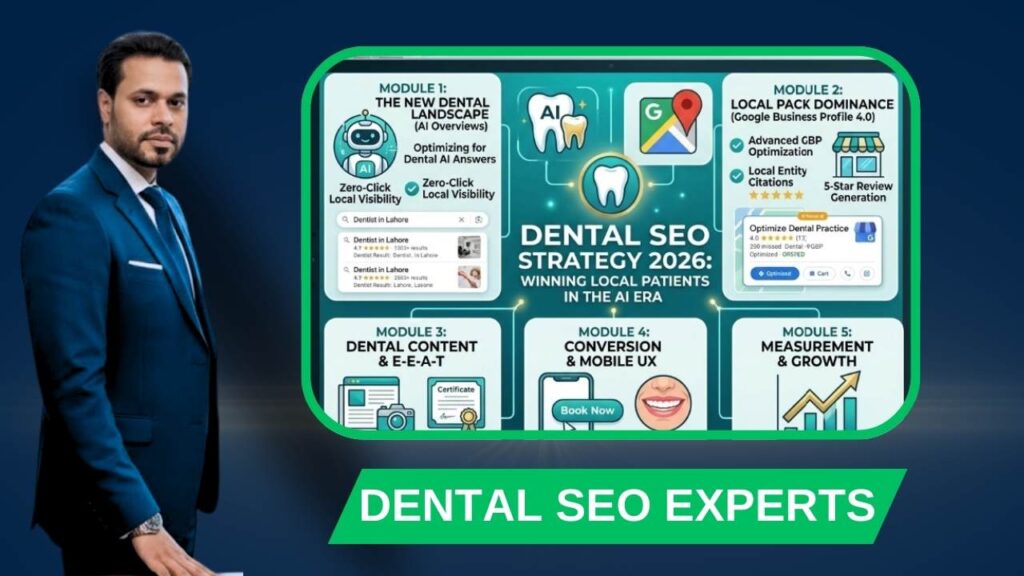
Dental SEO: Why Most Dental Practices Stay Invisible on Google (And How to Fix It)
77% of patients search online before booking a dentist. If your practice isn’t appearing in the top results, those patients are booking with your competitors.
According to research published by the Pew Research Center, 77% of patients search online before selecting a healthcare provider — and dentistry is no exception. Patients searching for a dentist in your city are making a booking decision within minutes. If your practice does not appear in the Google local pack or on the first page of organic results, you do not exist for those patients — regardless of how good your clinical care is.
Dental SEO is the process of optimising a dental practice’s online presence so it ranks prominently on Google for the searches patients use when they are ready to book. This includes everything from how your Google Business Profile is structured to how your website communicates trust signals, content relevance, and geographic authority to search engines. Done correctly, dental SEO becomes the most cost-efficient patient acquisition channel a practice can run — generating new bookings consistently without a recurring paid-ads budget.
JTC’s dental SEO services are led directly by Junaid Tariq — a Harvard and Google Certified digital marketing consultant with 18+ years of SEO experience, responsible for ranking over 100,000 keywords across 48 countries. To understand the depth of approach behind our work, learn about Junaid’s 18+ years of SEO experience before diving into what makes dental SEO a category of its own.
What Dental SEO Actually Is — Without the Jargon
Search engine optimisation in its broadest sense is the practice of making a website more visible in organic search results. Dental SEO applies that discipline specifically to dental practices — accounting for the highly local nature of patient searches, the trust requirements unique to healthcare, and the competitive dynamics of a geography-constrained market.
When a patient types “dentist near me” or “emergency dentist Manchester” or “Invisalign consultation London,” Google runs a complex evaluation of every dental website indexed in that area. It assesses relevance (does the site clearly cover this service?), authority (do other credible websites link to or mention this practice?), and trustworthiness (does the practice have verified reviews, consistent contact details, and a secure site?). Dental SEO is the systematic work of building and communicating all three signals to Google — so your practice appears where patients are looking.
The outcome dentists actually care about is not a ranking number — it is a filled appointment book. Every SEO decision JTC makes for dental clients is evaluated against one question: will this bring more patients through the door?
Key insight: A dental practice ranking in positions 1–3 for “dentist [city]” receives an estimated 45–60% of all clicks for that search. A practice in position 8 receives under 3%. The difference is not a technical detail — it is the difference between a busy diary and an empty one.
How Dental SEO Marketing Differs from General SEO
Applying generic SEO tactics to a dental practice website is one of the most common reasons dental practices see no return from SEO investment. Dental SEO marketing is a distinct discipline with three major differences from standard SEO practice: patient intent, local signals, and YMYL compliance.
Patient Intent Is Extremely High-Purchase
Someone searching for “dentist near me” is not researching — they are deciding. The search intent is transactional and local simultaneously, which means the content, page structure, and conversion path must be optimised for immediate booking action, not for extended information consumption. General SEO strategies optimised for top-of-funnel content will generate blog traffic that never converts to appointments.
Local Signals Are the Primary Ranking Factor
A dental practice does not compete globally — it competes within a radius of typically three to fifteen miles from the surgery. This means local SEO signals — Google Business Profile optimisation, NAP consistency, local citations, proximity signals, and review velocity — carry far more ranking weight for dental practices than the domain authority metrics that dominate general SEO thinking. Ignoring local signals while chasing national backlinks is a common and expensive misdirection.
YMYL and Google’s Healthcare Quality Standards
Google classifies dental and medical content under “Your Money or Your Life” (YMYL) — a category of content held to higher quality and accuracy standards because incorrect or misleading information could affect a reader’s health or finances. According to Google’s search quality documentation, YMYL pages require demonstrably high E-E-A-T: Experience, Expertise, Authoritativeness, and Trustworthiness. For dental practices, this means author credentials on clinical content, verifiable business details, patient review signals, and accurate medical information — all factors that generic SEO providers routinely overlook.
The 5 Pillars of Dental SEO Services
A complete dental SEO services programme is not a single tactic — it is a coordinated system of five interdependent components. Weakness in any one pillar limits the performance of the other four. Here is how each works and why each matters for patient acquisition.
Pillar 1: Local SEO and Google Business Profile
The Google local pack — the three-box map result that appears at the top of most “dentist near me” searches — is the highest-value real estate in dental search. Securing a position in the local pack requires a fully optimised Google Business Profile, consistent Name-Address-Phone data across all online directories, an active review acquisition strategy, and geo-targeted content on the website that confirms geographic relevance to Google’s local algorithm. For most dental practices, the local pack is where the majority of new patient enquiries originate.
Pillar 2: On-Page SEO
On-page optimisation ensures that each page of the dental website communicates clearly to Google what service it covers, who it serves, and where. This includes title tags and meta descriptions structured around the keywords patients actually search, H1 and heading hierarchy that mirrors Google’s content parsing logic, schema markup that explicitly identifies the site as a dental practice, and service pages that cover individual treatments — implants, whitening, Invisalign, emergency dentistry — as distinct, optimised pages rather than a single undifferentiated services list.
Pillar 3: Technical SEO
Technical SEO ensures Google can find, crawl, index, and render the dental website without obstruction. The most common technical issues affecting dental practices include slow page load times (particularly on mobile, where over 70% of local dental searches occur), HTTPS security lapses, broken internal link structures, duplicate content across location pages, and misconfigured canonical tags. These issues are invisible to practice owners but act as ranking suppressors that no amount of new content can overcome.
Pillar 4: Dental Content Strategy
A dental content strategy covers two distinct content types: commercial service pages that capture patients ready to book, and informational content that captures patients in an earlier research phase — “how much do dental implants cost,” “is Invisalign worth it,” “what happens at a dental hygienist appointment.” Both types contribute to organic traffic and patient acquisition, but they require different structures, intent alignment, and YMYL compliance approaches. Most dental websites publish only one type and miss the other entirely.
Pillar 5: Authority and Dental Backlink Building
Google treats backlinks from credible, relevant websites as votes of authority. For dental practices, this means acquiring citations from health directories (NHS, CareQuality Commission, Denplan), local business directories, dental association listings, and editorial links from local press or health publications. Dental backlink building for YMYL sites requires clean, relevance-focused acquisition — not bulk link schemes — because low-quality links in a healthcare context carry a higher penalty risk than in less sensitive categories.
Why Dental Practices Lose Patients to Competitors Ranking Above Them
The patient acquisition loss from low Google rankings is not abstract — it is measurable and ongoing. A practice ranking in position 7 for “dentist [city]” is losing an estimated 80-90% of the available click-through share compared to the top three results. Those clicks represent real patients who searched with intent to book and found a competitor instead. That competitor’s calendar fills; yours stays partially empty.
The practices winning these searches rarely have better dentistry — they have better SEO infrastructure. Their Google Business Profiles are complete, actively managed, and generating consistent five-star reviews. Their websites load in under two seconds on mobile. Their service pages are structured to match the exact language patients search. Their local citations are consistent across every directory Google cross-references when determining local pack eligibility.
The gap between a practice ranking first and a practice ranking fifth is almost always structural and fixable — not a reflection of clinical quality or patient satisfaction. This is precisely why dental SEO marketing, when executed by an experienced specialist, generates measurable ROI within a predictable timeframe.
Red flag to watch for: If a dental SEO provider cannot show you specific ranking improvements, local pack entries, or patient enquiry attribution data from their existing dental clients — not vague traffic graphs — they are not operating with the transparency a YMYL healthcare business deserves.
See real SEO results across industries including dental for the type of transparent performance data JTC provides. For dental-specific outcomes, our dental clinic SEO case study with real growth data shows the exact metrics tracked and the timeline of results from an active dental client engagement.
How Google Decides Which Dental Practice Appears in the Local Pack
Google’s algorithm for the dental Google Business Profile local pack — the three-result map box — evaluates three primary factors: Relevance, Distance, and Prominence. Understanding how each works is essential for any dental practice serious about patient acquisition through organic search.
- ►
Relevance — How well does your Google Business Profile match what the patient searched? This is determined by your business category selection, the services listed, the keywords present in your business description, and the content of your linked website. A profile that lists “General Dentistry” without specifying implants, whitening, or emergency appointments misses every search that includes those terms. - ►
Distance — How close is the practice to the searcher’s location or the location specified in the search? Distance is only partially within your control — but ensuring your address is consistent and verified across Google Maps, your website, and every citation directory helps Google accurately place you in relation to the searcher. - ►
Prominence — How well-known and trusted is the practice in Google’s assessment? This encompasses review volume and star rating, the number and quality of citations from other websites, and the overall authority of the linked dental website. Prominence is the most effort-intensive factor — and the one where systematic dental SEO investment pays the highest dividend.
Practices that dominate the local pack have typically invested 6–18 months in structured local SEO work — not just claimed their Google Business Profile and hoped for the best. The local pack is competitive, and proximity alone is not enough when a competitor three streets away has 300 reviews, a fully optimised profile, and a well-structured dental website behind it.
Dental SEO Marketing Strategy: What a Full Campaign Looks Like Month by Month
Sustainable dental search rankings are built in phases — not all at once. The sequence matters. Technical foundations must be in place before content can rank. Local signals must be consistent before a Google Business Profile will appear in the top three. Authority must be earned before competitive keywords become accessible. Here is the structured dental SEO marketing timeline JTC follows for dental practice clients.
Phase |
Timeframe |
Primary Activities |
Expected Outcome |
|---|---|---|---|
Foundation |
Months 1–2 |
Full SEO audit, technical fixes, Google Business Profile optimisation, NAP consistency audit, competitor analysis, keyword mapping |
Crawl errors resolved, site health improved, GBP fully optimised and verified |
On-Page Build |
Months 3–4 |
Service page optimisation, schema markup implementation, content gap analysis, citation building, first content assets published |
Improved indexation, early keyword movement, local citations established |
Authority Growth |
Months 5–6 |
Backlink acquisition, review strategy execution, content publishing cadence established, local pack monitoring |
Visible ranking improvements for secondary keywords; local pack appearances increasing |
Competitive Dominance |
Months 7–12 |
Priority keyword ranking push, topical content expansion, authority link building, conversion rate review on key landing pages |
Page 1 rankings for primary patient acquisition keywords, consistent local pack presence, measurable new patient attribution |
Once organic rankings generate consistent patient enquiry volume, the priority shifts to ensuring those visitors convert into booked appointments. This is where SEO and lead generation work together — a gap most dental SEO providers leave wide open. To understand this integration, see how we turn your dental SEO traffic into booked appointments through structured conversion optimisation.
JTC’s Dental SEO Services: What’s Included and What Clients See
JTC’s dental SEO programme is a fully managed service — not a template package applied uniformly across practices. Every engagement begins with a discovery audit tailored to the practice’s location, competitive set, existing website infrastructure, and patient acquisition goals. What is included reflects what the practice actually needs — not a predetermined list of deliverables that may or may not address the real constraints.
- ■
Full dental SEO audit — technical health, on-page analysis, local presence review, competitor gap assessment, and keyword opportunity mapping specific to the practice’s geography and services. - ■
Google Business Profile management — category optimisation, service listings, photo strategy, review response management, and Q&A section optimisation to maximise local pack eligibility. - ■
Service page optimisation — dedicated, optimised pages for high-value treatments including implants, Invisalign, dental whitening, emergency dentistry, and hygiene appointments. - ■
Technical SEO remediation — site speed, mobile performance, schema markup, crawl budget management, and indexation health — with implementation support for your developer or CMS. - ■
Dental content strategy and production — a publishing programme covering both commercial service pages and informational content targeting patients at every stage of the decision journey. - ■
Monthly performance reporting — keyword movement, local pack presence, organic traffic, and patient enquiry attribution so you know precisely what the SEO investment is generating in new bookings.
For an understanding of the broader methodology behind JTC’s approach, see our full-service SEO agency and proven methodology. Dental practices looking for social proof before committing can read what clients say about working with our SEO team.
Dental SEO Timeline, Cost, and How to Calculate ROI
How Long Does Dental SEO Take?
Realistic dental SEO timelines follow a consistent pattern: technical improvements and Google Business Profile optimisations generate visible local pack movement within 60–90 days. Secondary keyword rankings typically show meaningful improvement by month four. Primary patient acquisition keywords — “dentist [city],” “implants [city]” — reach page one for most practices between month six and twelve, depending on existing domain authority and competitive intensity in the local market.
Any provider promising page one rankings within 30 days for competitive dental keywords is either targeting keywords no one searches for or using tactics that will trigger a Google penalty. Sustainable dental search rankings require consistent, structured work over six to twelve months — and then compound over time without the recurring cost of paid advertising.
What Does Dental SEO Cost?
Monthly dental SEO retainers from experienced, specialist providers typically range from £800–£3,000 per month in the UK and $1,000–$4,000 per month in North American markets, depending on the scope — number of locations, treatment category competition, whether content production is included, and whether link building is in scope. Project-based audits and strategy engagements are typically priced separately for practices not yet ready for ongoing management.
How to Calculate Dental SEO ROI
This is the calculation most dental SEO providers skip — and it is the most important one. Start with the average lifetime value of a new dental patient. For a general practice, this is typically £2,000–£5,000 over three to five years of treatment. For a cosmetic or implant practice, this figure rises considerably. If an SEO programme generates 10 additional new patient enquiries per month at a 50% conversion rate, that is five new patients per month. At a £3,000 lifetime value, that is £15,000 in lifetime patient revenue per month from a marketing investment of £1,500.
The correct question is not “how much does dental SEO cost?” — it is “what is the cost of not ranking?” Every month a competitor ranks above you in the local pack, they are receiving patients who would otherwise have called your practice.
For a deeper understanding of what to expect from an SEO engagement before you commit budget, read our free guide to understanding SEO before you hire — it covers the questions to ask, the red flags to avoid, and how to structure accountability into any SEO provider relationship.
Red Flags to Avoid When Hiring a Dental SEO Provider
The dental SEO market includes a significant number of providers offering cheap, templated services that produce no measurable patient acquisition results. Some actively damage practice websites through spammy link building or over-optimised content that triggers Google’s quality filters. Knowing the warning signs before you engage protects both your budget and your website’s ranking potential.
- ■
Guaranteed rankings within 30 days — No legitimate SEO provider can guarantee specific rankings within a short timeframe. Google’s algorithm cannot be manipulated on a fixed schedule. - ■
No dental-specific experience — A provider who cannot show you specific dental practice case studies is applying generic SEO logic to a healthcare-specific challenge. YMYL compliance, local pack strategy, and patient acquisition intent require sector knowledge. - ■
Reporting only on traffic, never on patient enquiries — Organic traffic is a vanity metric if it does not translate into appointment bookings. Any provider that cannot or will not connect SEO performance to patient acquisition data is measuring the wrong thing. - ■
Ownership of your website or Google Business Profile — Your website, your Google Business Profile, and your domain are practice assets. Any SEO provider that insists on owning or controlling them as a condition of the engagement is creating a dependency that puts your business at risk if you ever change providers.
The Experience Behind JTC’s Dental SEO Results
Clients include PTCL, Stylo, Rozee, RDX Sports, and Orient Electronics — alongside dental, healthcare, and local service businesses where patient acquisition is the primary commercial goal.
Frequently Asked Questions
What is dental SEO and why do dentists need it?
Dental SEO is the process of optimising a dental practice’s website and online presence to appear prominently on Google when patients search for a dentist in their area. Dentists need it because 77% of patients search online before booking, and practices that do not rank on page one are invisible to the majority of prospective new patients — regardless of their clinical quality or location.
How long does dental SEO take to show results?
Most dental practices see measurable ranking improvements within 60–90 days of technical and Google Business Profile work being completed. Significant movement on primary patient acquisition keywords typically occurs between months four and six. Full competitive page one rankings for the most contested local keywords generally require six to twelve months of consistent, structured SEO work. Results compound over time — unlike paid ads, which stop the moment budget is withdrawn.
How much does dental SEO cost?
Specialist dental SEO services typically cost between £800 and £3,000 per month in the UK, and $1,000 to $4,000 per month in North American markets, depending on scope, competition level, and whether content production and link building are included. The more relevant question is ROI: a programme generating five additional new patients per month at a £3,000 lifetime value produces £15,000 in patient revenue from a £1,500 SEO investment.
What is the difference between dental SEO and regular SEO?
Dental SEO marketing differs from general SEO in three critical ways: it operates in a local, geography-constrained competitive environment; it targets patients with high-purchase intent who are ready to book rather than browse; and it is subject to Google’s YMYL (Your Money or Your Life) quality standards, which require higher levels of credibility, accuracy, and E-E-A-T compliance than most other business categories. Generic SEO tactics applied to dental websites routinely produce weak results because they ignore these distinctions.
Can I do dental SEO myself, or do I need an agency?
Basic dental SEO tasks — claiming and verifying your Google Business Profile, requesting patient reviews, ensuring consistent contact details across directories — can be managed in-house. However, competitive page one rankings in most markets require technical expertise, structured content strategy, backlink acquisition, and ongoing analysis that exceeds what most practice managers can execute alongside their day jobs. The practices that attempt DIY SEO typically plateau early and then spend 12–18 months correcting errors before professional work can begin.
What does a dental SEO service include?
A comprehensive dental SEO service includes a full website and local presence audit, Google Business Profile optimisation, technical SEO remediation, service page optimisation for individual treatments, a dental content strategy, citation building, backlink acquisition, review strategy, and monthly performance reporting tied to patient enquiry attribution. The specific mix depends on where the practice’s biggest ranking constraints currently sit — which is why a proper audit is the mandatory starting point for any credible engagement.
How do I know if my dental SEO is working?
Dental SEO performance should be measured through a combination of keyword ranking movement, Google Business Profile visibility (impressions, clicks, direction requests, phone calls), organic website traffic, and — most importantly — new patient enquiries attributable to organic search. If your provider reports only traffic without connecting it to patient acquisition, that is a reporting problem. Effective dental SEO ROI is calculable and should be tracked from month one against a baseline.
What is local SEO for dentists?
Local SEO for dentists is the specific set of optimisation activities designed to make a dental practice appear in the Google local pack — the three-box map result — and in geographically targeted organic search results for patients searching within the practice’s catchment area. It includes Google Business Profile management, NAP citation consistency, local content creation, review acquisition, and proximity signal optimisation. For most dental practices, local SEO delivers higher patient acquisition impact than any other digital marketing channel.
Is dental SEO better than Google Ads for patient acquisition?
Dental SEO and Google Ads serve different timeframes rather than competing directly. Ads provide immediate visibility but stop delivering the moment the budget stops. SEO takes longer to build but generates compounding, sustainable patient acquisition without a per-click cost. Most high-growth dental practices use both — Ads for immediate new patient volume during the SEO build phase, and SEO to reduce long-term patient acquisition cost once rankings are established. The practices that rely solely on ads are permanently exposed to rising click costs and competitor bidding.
How do I start with JTC’s dental SEO services?
The first step is a free dental SEO audit. We review your current website, Google Business Profile, local pack presence, and keyword rankings — then provide a clear picture of where your practice stands relative to local competitors and what it would take to move to page one. There is no obligation, and the audit takes approximately 30 minutes to discuss. Get your free dental SEO audit today to begin.
Ready to Fill Your Appointment Book With Patients Finding You on Google?
JTC’s dental SEO services are built around one goal: more patients, consistently. Get a free audit and find out exactly where your practice stands — and what it will take to get above your competitors.