
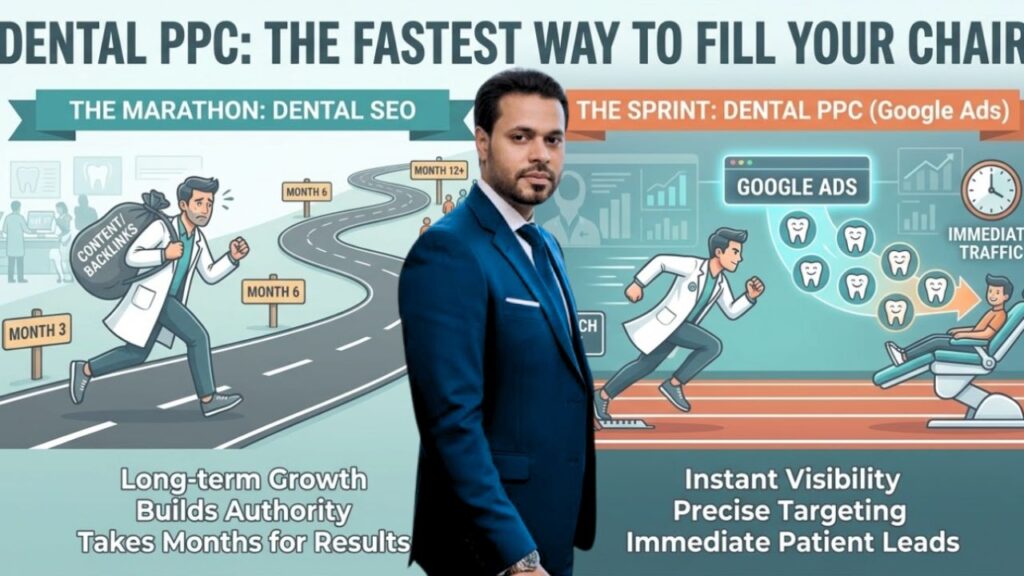
Dental PPC: Why Google Ads Are the Fastest Way to Fill a Dental Chair
Patients are searching for a dentist right now. Dental PPC puts your practice in front of them before your competitors — and you only pay when they click.
Research from WordStream shows that 41% of all Google users click one of the top three paid search results. For high-intent searches like “emergency dentist near me” or “dental implants [city],” that percentage climbs even higher — because the patient is not browsing, they are deciding. Most dental practices are not in those top positions. Their chairs stay partially empty not because of weak clinical care, but because their ads are either absent, poorly targeted, or leaking budget on traffic that never converts into booked appointments.
Dental PPC — pay-per-click advertising on platforms like Google Ads — is the fastest patient acquisition channel available to a dental practice. Unlike SEO, which builds organic rankings over months, a well-configured PPC campaign can begin generating appointment enquiries within days of launch. The model is straightforward: you bid on the keywords patients search when they need a dentist, your ad appears at the top of the results page, and you pay only when a patient clicks through to your website or calls your practice directly.
JTC’s dental PPC campaigns are managed directly by Junaid Tariq — a Harvard and Google Certified digital marketing consultant with 18+ years of experience and over $20 million in paid ad spend managed across industries including healthcare. For background on the expertise behind every campaign decision, learn about the PPC expert behind our dental advertising campaigns. The results speak clearly — but the methodology is what separates sustained patient acquisition from short-lived ad spend.
What Dental PPC Is — and Why You Only Pay for Real Interest
Pay-per-click advertising is a digital advertising model where the advertiser pays only when a user actively clicks on their ad — not simply for having the ad displayed. For dental practices, this means a practice can appear at the very top of Google for “dentist Manchester” or “Invisalign consultation London” and pay nothing unless a patient actively chooses to engage with that ad.
This cost model makes dental PPC one of the most accountable forms of marketing available to a practice. Every pound or dollar spent is directly traceable to a specific search term, a specific click, and — when tracking is set up correctly — a specific phone call or appointment booking request. Compare this to print advertising, radio, or generic display banners, where spend disappears into audience impression metrics with no clear line to a new patient sitting in your chair.
The critical variable is intent. A patient searching “emergency dentist open Saturday” is not casually browsing — they need a dentist today. Dental PPC targets that patient at precisely the moment of maximum intent, displaying your practice’s ad above every organic result on the page. The window between their search and their booking decision is minutes. Being present in that window is everything.
Why Dental PPC Marketing Differs from General PPC
Running dental PPC campaigns with the same approach used for an e-commerce store or a software company is one of the most common reasons dental practices waste their ad budget. Dental PPC marketing operates under constraints that most generic PPC managers are not equipped to navigate — and ignoring those constraints costs practices real money.
Patient Intent Is Local and Immediate
Dental patients searching on Google are overwhelmingly local and ready to act. The geographic radius of a dental practice’s relevant audience is typically three to fifteen miles — meaning ad targeting must be tightly geo-fenced, and bidding strategy must account for hyper-local competition rather than broad market dynamics. A dental PPC campaign bidding nationally on dental keywords without location targeting will spend a practice’s entire budget on clicks from patients who will never book because they live four hours away.
Healthcare Ad Policy Compliance
Google enforces specific advertising policies for healthcare providers, including restrictions on before-and-after imagery, patient testimonials in ad copy in some jurisdictions, and certain claims about treatment outcomes. Dental ads must comply with these policies to remain active — and violations can result in ad suspension without notice. According to Google’s quality and compliance documentation, healthcare advertisers are held to higher transparency standards across both paid and organic channels. Managing dental PPC without this compliance knowledge creates exposure that can shut down a practice’s entire ad account.
YMYL Quality Requirements in the Ad Ecosystem
Google’s Quality Score — the algorithm that determines how much you pay per click and how prominently your ads appear — evaluates the relevance and trustworthiness of the landing page the ad points to. For dental practices, this means a high-quality, professionally structured landing page that communicates credentials, treatment detail, and trust signals is not optional. A generic homepage receiving dental PPC traffic will earn poor Quality Scores, higher costs-per-click, and weaker ad positions — making the campaign structurally unprofitable regardless of how good the targeting is.
How PPC Dental Marketing Works: From Keyword Bid to Booked Appointment
Understanding the full patient journey from a Google search to a confirmed booking is the foundation of effective PPC dental marketing. Most practices see only the cost side of the equation — their monthly ad spend — without a clear picture of what happens at each step between a click and a filled chair. Here is how a properly constructed dental PPC campaign works end to end.
- ►
Step 1: Keyword Research and Intent Mapping — Every viable search phrase a prospective patient might use is identified and categorised by intent: emergency (book today), elective (research phase), or high-value treatment (implants, Invisalign, whitening). Each intent tier receives a separate campaign or ad group with tailored messaging. - ►
Step 2: Ad Copy Creation — Ad headlines and descriptions are written to match the search term precisely, include the practice’s unique differentiators (same-day appointments, NHS or private, specific accreditations), and feature a clear call to action that drives either a phone call or a landing page visit. - ►
Step 3: Landing Page Alignment — Each campaign sends traffic to a purpose-built landing page — not the homepage — that directly mirrors what the ad promised. An implant ad goes to an implant page. An emergency dentist ad goes to a same-day appointment page with a visible phone number above the fold. - ►
Step 4: Conversion Tracking — Phone call tracking, form submission events, and appointment booking confirmations are all captured and attributed back to the specific ad and keyword that generated the interaction. Without this layer, there is no reliable data on which campaigns are actually producing new patients. - ►
Step 5: Bid Optimisation and Continuous Refinement — Bids are adjusted based on what the data shows: which keywords are generating appointments at an acceptable cost per new patient, which ad variations are converting at higher rates, and which negative keywords should be added to prevent irrelevant spend.
For practices that want to understand how we turn ad clicks into confirmed bookings rather than just website visits, see how we turn dental ad clicks into booked appointments — the conversion infrastructure that sits between traffic and revenue.
The 5 Types of Dental PPC Ads and When to Use Each
Dental pay-per-click advertising is not a single format — it is a family of ad types, each suited to different patient acquisition goals and stages of the patient journey. Understanding which format to deploy and when is the difference between a campaign that fills chairs and one that burns budget on irrelevant impressions.
Ad Type |
Best For |
Cost Model |
Speed of Results |
Recommended For |
|---|---|---|---|---|
Search Ads |
Capturing patients actively searching for a dentist right now |
CPC (pay per click) |
Immediate — hours to days |
All dental practices; highest priority format |
Display Ads |
Brand awareness across Google’s partner websites and apps |
CPM or CPC |
Slower — weeks for measurable impact |
Practices investing in longer-term brand visibility |
Local Services Ads (LSA) |
High-trust local patient calls, appearing above standard search ads |
Pay per lead (call or message) |
Fast once verified — days |
Verified practices wanting highest-visibility local placement |
Performance Max |
Automated multi-channel reach across Search, Display, Maps, Gmail, YouTube |
CPC / target CPA |
4–6 weeks learning period before optimisation |
Established practices with strong conversion tracking in place |
Remarketing |
Re-engaging website visitors who did not book on their first visit |
CPM or CPC |
Ongoing — works as long as campaigns run |
Practices with high website traffic wanting to recover lost leads |
Google Local Services Ads deserve particular attention — they are underutilised by most dental practices despite appearing above standard Google Ads in the search results. LSAs display the practice’s name, star rating, years in business, and a direct call button, and the cost model charges per verified lead rather than per click. For practices that have completed Google’s verification process, LSAs often deliver the lowest cost per new patient enquiry of any paid format.
Dental PPC ROI: How to Calculate Your Cost Per New Patient
Most dental PPC content mentions ROI without ever showing a dental practice owner how to calculate it. Here is the actual framework. Every dental practice running paid advertising should be able to answer three questions: what is my cost per click, what is my click-to-enquiry conversion rate, and what is the lifetime value of a new patient?
Dental PPC ROI Calculation — Worked Example:
► Monthly ad spend: £1,500
► Average cost per click (dental, UK): £4–8
► Clicks from £1,500 budget: approx. 200–375 clicks
► Landing page conversion rate (enquiry form or call): 8–12%
► Enquiries generated: approx. 20–45 per month
► Appointment booking rate from enquiries: 50%
► New patients booked: 10–22 per month
► Lifetime patient value (general practice): £2,000–£4,000
► Revenue generated: £20,000–£88,000 in lifetime patient value from a £1,500 monthly investment.
The variables in this calculation — cost per click, conversion rate, and booking rate — are all improvable through campaign management. A poorly managed campaign might achieve a 3% conversion rate and a £30 cost per enquiry. A well-managed campaign with purpose-built landing pages, strong ad copy, and properly configured call tracking might achieve a 12% conversion rate and a £6 cost per enquiry. That difference, compounded over 12 months, represents the gap between dental PPC that feels like a cost and dental PPC that functions as the practice’s most profitable growth channel.
For real campaign performance data across JTC’s dental and healthcare clients, see real campaign results from our paid advertising work and how we grew a dental clinic through targeted marketing.
Dental PPC vs Dental SEO: Why the Best Practices Use Both
The question dental practice owners most frequently ask when exploring digital marketing is whether to invest in PPC or SEO. The answer is that this is the wrong question — these channels are not substitutes. They are designed to solve different problems across different timeframes, and the practices generating the most consistent new patient volume run both in a coordinated strategy.
Dental PPC delivers immediate visibility and patient acquisition from day one of a campaign. It is the right tool when a practice needs to fill chairs quickly — after a slow quarter, following a new associate joining, or during a promotion period for a specific treatment. The limitation is that dental PPC patient acquisition cost is ongoing: stop paying for ads, and the patients stop arriving.
Dental SEO builds organic visibility that compounds over time and eventually delivers new patients at near-zero marginal cost per acquisition. The limitation is time: SEO takes six to twelve months to deliver competitive rankings in most local markets. Running ads during the SEO build phase solves this gap entirely — PPC generates the immediate patient flow while SEO builds the long-term, cost-efficient foundation underneath it.
Once organic rankings are established, many practices reduce their PPC spend proportionally — maintaining ads for high-value treatment keywords and emergency searches while organic results handle general dentistry searches. To understand how the two channels work together in an integrated dental marketing programme, combine dental PPC with long-term dental SEO for maximum patient reach.
Why Most Dental PPC Campaigns Fail — and What Good Management Actually Prevents
A significant proportion of dental practices that have tried Google Ads and concluded “it doesn’t work for dentists” were running campaigns with one or more of the following structural failures. These are not edge cases — they are the norm in dental advertising managed by generalist PPC providers without sector-specific knowledge.
The most common dental PPC campaign failures:
- ►
Sending traffic to the homepage — The homepage is not a landing page. A patient who clicked an implant ad and lands on a general homepage with no clear implant content and no booking prompt will leave within seconds. Each campaign requires a dedicated, conversion-optimised landing page. - ►
Broad keyword matching without negative keyword lists — Without negative keywords, a dental practice’s budget gets consumed by searches like “dentist salary,” “dentist jokes,” or “free dental treatment” — people who will never become paying patients. Negative keyword hygiene is a weekly task, not a setup-and-forget configuration. - ►
No call tracking — Most dental practice enquiries arrive by phone, not web form. Without dynamic call tracking that connects a phone call to the specific Google Ad keyword that generated it, there is no reliable data on which campaigns are working. Budgets end up allocated by guesswork rather than performance. - ►
Insufficient geographic targeting — Running ads nationally or county-wide when patients will only travel three miles for a routine appointment wastes up to 70% of the dental PPC budget on geographically irrelevant traffic. Hyper-local radius targeting or postcode-level exclusions are essential for cost efficiency.
Understanding these failure points is one of the reasons JTC’s dental PPC management begins with a full audit of any existing campaign infrastructure before a single pound of new ad spend is committed. See what clients say about our PPC and marketing results to understand the standard of accountability JTC holds its own campaigns to.
What JTC’s Dental PPC Management Service Includes
JTC’s dental PPC management is a fully handled service — not a template campaign applied indiscriminately. Every engagement is led by Junaid Tariq, an award-winning digital marketing consultant with $20 million in managed ad spend and verified dental clinic campaign results. The service scope is defined by what the practice actually needs to fill chairs efficiently, not by a predetermined package.
- ■
Dental keyword research and intent mapping — Comprehensive identification of all patient-relevant search terms across emergency, elective, cosmetic, and high-value treatment categories, with negative keyword lists built before campaigns launch. - ■
Campaign setup and ad copy creation — Responsive search ads, ad extensions (callout, sitelink, call, location), and structured campaign architecture with separate ad groups per treatment category and intent tier. - ■
Dedicated landing page creation or optimisation — Treatment-specific landing pages designed for conversion, YMYL compliance, and Quality Score performance — with clear booking calls to action, trust signals, and mobile-first design. - ■
Conversion tracking setup — Dynamic call tracking, form submission events, and Google Tag Manager implementation to connect every patient enquiry back to the specific ad and keyword that generated it. - ■
Google Local Services Ads management — Setup, verification, and ongoing management of LSA campaigns for eligible dental practices, including review strategy to maintain the rating score that determines LSA prominence. - ■
Monthly performance reporting — Clear, practice-owner-level reporting connecting ad spend to new patient enquiries, cost per new patient, and return on ad spend — with strategic recommendations for the following month.
For practices exploring the broader scope of JTC’s paid advertising capabilities beyond dental, see our full PPC advertising services and management approach.
Dental PPC Pricing: What to Expect at Different Budget Levels
Dental PPC costs comprise two separate figures: the ad spend budget (paid directly to Google) and the management fee (paid to the agency or specialist managing the campaigns). These are distinct, and conflating them is one of the most common sources of confusion when dental practices compare providers.
Ad Spend Budget
Average cost per click for dental keywords in the UK typically ranges from £3 to £12 per click depending on treatment type and local competition. Emergency dentistry and implant keywords sit at the higher end. A practice wanting to generate 15–25 patient enquiries per month with a 10% landing page conversion rate would typically require a monthly ad spend of £1,000–£2,500. Lower budgets are viable for lower-competition locations or narrowly targeted treatment campaigns.
Management Fee
Professional dental PPC management from an experienced specialist typically ranges from £500 to £1,500 per month, depending on campaign complexity, the number of treatment categories in scope, and whether landing page development is included. Providers charging below this range are typically applying automated tools or minimal human oversight — which is precisely the management gap that produces the campaign failures outlined above.
Before committing to any dental PPC investment, read our free guide to understanding digital marketing before you hire — it covers how to evaluate any digital marketing provider and the accountability structures that protect your investment.
The Track Record Behind JTC’s Dental PPC Campaigns
Clients include PTCL, Stylo, Rozee, RDX Sports, and Orient Electronics — alongside dental and healthcare practices where patient acquisition cost and campaign accountability are non-negotiable.
Frequently Asked Questions
What is dental PPC and how does it work?
Dental PPC is a form of paid advertising where a dental practice’s ad appears at the top of Google search results for relevant patient searches, and the practice pays only when a patient clicks the ad. Campaigns are structured around the keywords patients search — “dentist near me,” “dental implants,” “emergency dentist” — and target a specific geographic radius around the practice. When configured correctly, dental PPC can generate new patient enquiries within days of launch.
How much does dental PPC advertising cost?
Dental PPC costs comprise two elements: the ad spend budget paid directly to Google, and the management fee paid to whoever runs the campaigns. In the UK, ad spend of £1,000–£2,500 per month is a typical starting point for a practice targeting meaningful new patient volume. Average cost per click for dental keywords ranges from £3 to £12 depending on treatment type and local competition. Management fees from specialist providers typically run £500–£1,500 per month on top of ad spend.
How quickly does dental PPC generate new patients?
A properly configured dental PPC campaign can begin generating patient enquiries within 24–72 hours of going live. Unlike SEO, which builds organic rankings over months, PPC provides immediate top-of-page visibility for the keywords your target patients are searching right now. Most practices see their first enquiries from a new campaign within the first week, with volume increasing as the campaign optimises over the first 30 days.
What is the difference between dental PPC and dental SEO?
Dental PPC delivers immediate paid visibility at the top of Google — you pay per click, and results start immediately but stop when the budget stops. Dental SEO builds organic (unpaid) rankings over six to twelve months that generate patients at near-zero cost per acquisition once established. The ideal dental marketing strategy uses both: PPC to fill chairs immediately while SEO builds the long-term foundation that reduces patient acquisition cost over time.
How do I calculate ROI from dental PPC campaigns?
Calculate dental PPC ROI by dividing your total ad spend and management cost by the number of new patients acquired, to get your cost per new patient. Then multiply new patients by their average lifetime value to the practice. For example: £3,000 total investment generating 15 new patients at a £3,000 lifetime value produces £45,000 in lifetime patient revenue — a 15:1 return. The key is having accurate call tracking and booking attribution so these numbers reflect reality rather than estimates.
What types of dental PPC ads work best?
Google Search Ads are the highest-priority format for most dental practices — they capture patients at peak booking intent. Google Local Services Ads (LSAs) deliver exceptional ROI for verified practices because they appear above standard search ads and charge per lead rather than per click. Remarketing campaigns are highly cost-efficient for re-engaging website visitors who did not book on their first visit. The right mix depends on budget, practice type, and how much conversion tracking infrastructure is already in place.
Why do most dental PPC campaigns fail?
The most common dental PPC campaign failures are: sending ad traffic to the homepage instead of a treatment-specific landing page, using broad keyword matching without negative keyword lists (which burns budget on irrelevant searches), running no call tracking so there is no data on which ads generate actual appointments, and targeting too wide a geographic area for a service patients will only travel a few miles to access. These failures are all preventable — and all common in campaigns managed without dental sector expertise.
Should I run dental PPC myself or hire a specialist?
Google Ads has a low barrier to setup and a high barrier to profitability. Practices that manage their own campaigns typically see cost-per-click rates 30–50% higher than specialist-managed accounts, poor Quality Scores due to landing page misalignment, and no systematic negative keyword management. The management fee for a specialist pays for itself within the first month in reduced wasted spend alone — before accounting for improved conversion rates. Self-managed campaigns are appropriate for very small test budgets, not for practices relying on PPC as a primary patient acquisition channel.
What are Google Local Services Ads and should my dental practice use them?
Google Local Services Ads (LSAs) are a premium ad format that appears above standard Google Ads in local searches. They display the practice name, star rating, number of reviews, and a direct call button — and charge per verified lead rather than per click. For dental practices that complete Google’s background verification process and maintain a strong review rating, LSAs often deliver the lowest cost per new patient enquiry of any paid format. They are particularly effective for emergency and general dentistry searches where patients call directly rather than browsing multiple websites.
How do I get started with JTC’s dental PPC management?
The starting point is a free dental PPC audit. JTC reviews your existing Google Ads account (if one exists), your landing pages, your conversion tracking setup, and your competitive landscape — then provides a clear diagnosis of what is working, what is wasting budget, and what a restructured campaign could realistically deliver in new patient terms. The audit takes approximately 30 minutes to walk through and carries no obligation. Get a free dental PPC audit and campaign review to begin.
Ready to Fill Your Diary With Patients Who Found You on Google Today?
JTC’s dental PPC management is built around one number: your cost per new patient. Get a free audit and find out exactly where your current campaign is leaking budget — and what a properly structured campaign could deliver.