
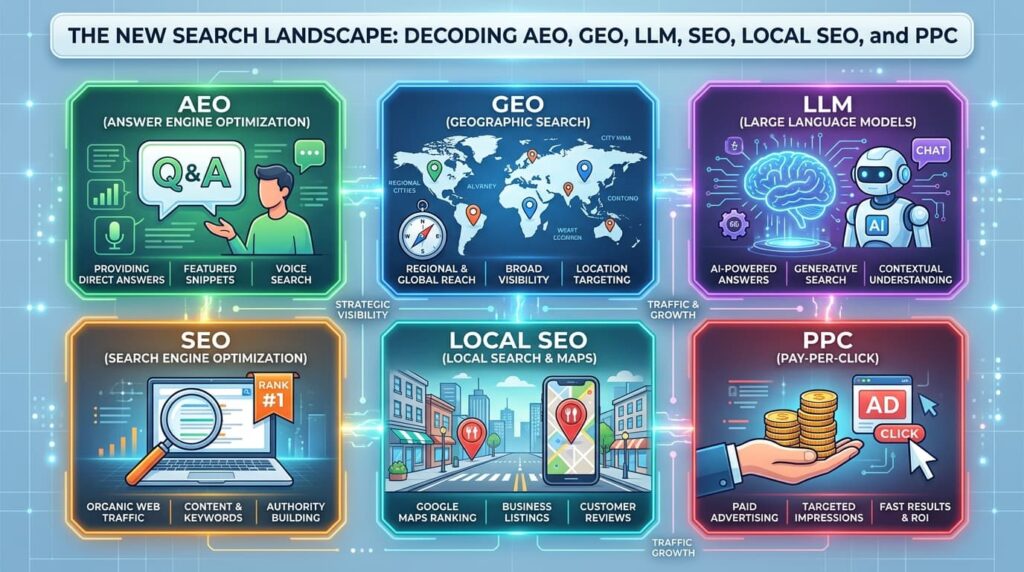
Every month a new acronym lands in marketing conversations. AEO. GEO. LLM Optimization. And business owners keep asking: is this replacing SEO? Should I stop running Google Ads? After 18+ years and 500+ clients across 48 countries, the honest answer is no — but how you combine these six channels in 2025 will determine whether you generate leads or get left behind to your competitors.
AI search traffic grew 527% year-over-year between January and May 2024–2025. Zero-click searches — where users get their answer without visiting a website — hit 69% of all searches by May 2025. Google AI Overviews now appear on 18% of commercial queries, up from 8% just a year ago. If your strategy is purely traditional SEO services and paid ads without the AI layer, you are already invisible to a significant portion of your potential audience.
This guide defines all six disciplines — AEO, GEO, LLM Optimization, Traditional SEO, Local SEO, and PPC — compares them across 15 strategic factors, provides four real-world case studies, and gives you an exact decision framework for when to use each. If you have ever wondered why your website is not getting traffic from Google despite running ads, this article explains the exact gaps.
⚡ THE ONE INSIGHT THAT CHANGES EVERYTHING
These six channels are not competitors — they are layers. SEO is the foundation. AEO gets you position zero. GEO puts you inside AI answers. LLM Optimization makes you the source AI trusts. Local SEO dominates your city. PPC gets you leads today while the organic channels mature. Removing any single layer leaves measurable revenue on the table. Our client case studies confirm this consistently across every industry we have worked in.
What Each Term Actually Means — Plain English Definitions
Before comparing these channels, let us establish precise definitions. The industry created these labels without agreeing on exact meanings — so confusion is common even among marketing professionals. Here is how leading practitioners, including Princeton researchers, Neil Patel, and Google’s own documentation, define them in 2025.
For a deeper introduction to SEO specifically, Junaid’s free SEO guide for business owners is a great starting point before reading this comparison.
Search Engine Optimization
SEO — according to Wikipedia’s SEO definition — is the process of improving a website so search engines can crawl, index, rank, and send qualified organic traffic. It blends technical health, content quality, keyword strategy, and authority signals. Our SEO services cover all three pillars.
Answer Engine Optimization
AEO structures content to win direct answers inside search results — featured snippets, People Also Ask boxes, voice search, and AI overview answers. It targets question-based intent: “what is”, “how to”, “why does”. AEO is what separates businesses that rank from businesses that answer.
Generative Engine Optimization
GEO was formally defined by Princeton University researchers in November 2023. It shapes your content so generative AI systems find, trust, and synthesize it into their responses. GEO optimizes for summary inclusion — being cited when ChatGPT or Perplexity compiles an answer from multiple sources. Our AI consulting services cover GEO strategy.
Large Language Model Optimization
LLM Optimization makes your content machine-readable, semantically interpretable, and extractable by LLMs across any AI surface — ChatGPT, Claude, Gemini, Perplexity. Where GEO asks “will AI cite me?”, LLM Optimization asks “does AI understand and accurately represent my brand?” It is the deepest layer of AI visibility.
Local Search Optimization
Local SEO optimizes your business to appear in location-based searches and Google Maps. It covers Google Business Profile optimization, local citations, reviews, and geo-targeted content. For service businesses in Lahore, Karachi, Dubai, or London — our guide to finding a local SEO expert explains the process in detail.
Pay-Per-Click Advertising
PPC — as defined by Wikipedia’s pay-per-click entry — is a paid advertising model where you pay per click. Google Ads, Meta Ads, LinkedIn Ads. Delivers traffic within hours. Average ROI: 200% ($2 per $1 spent). See our PPC advertising services for full campaign management.
🧠 The Mental Model: Six Layers, One Goal
Framework adapted from Team4.agency (2025) with data from ZipTie.dev, Microsoft Clarity, Princeton GEO Study
The Full 15-Factor Comparison Table
Most comparison articles cover 3–4 channels. This table covers all six across every strategic factor that matters for real business decisions. Whether you are looking for a professional SEO consultant in Pakistan or trying to understand which channel to prioritize with a limited budget — this table answers both questions.
Factor |
SEO |
AEO |
GEO |
LLM Opt. |
Local SEO |
PPC |
|---|---|---|---|---|---|---|
🎯 Primary Goal |
Rank on SERPs |
Position zero answers |
AI citation |
AI trust & recall |
Dominate Maps |
Instant leads |
📍 Where It Appears |
Google organic |
Snippet, PAA, Voice |
AI Overviews, Perplexity |
ChatGPT, Claude, Gemini |
Google Maps, local pack |
Google Ads, Meta, LinkedIn |
⏳ Time to Results |
3–6 months |
4–8 weeks |
60–90 days |
4–6 months |
2–3 months |
Hours |
💰 Cost Level |
Medium |
Low–Medium |
Medium |
Medium–High |
Low–Medium |
High (ongoing) |
📈 Long-term ROI |
500–1,300% |
High (compounds) |
Very high (future) |
Very high (future) |
Very high (local) |
~200% (stops w/ spend) |
🔄 Conversion Quality |
14.6% organic avg |
Medium |
3x industry avg |
4.4x visitor value |
Very High (intent) |
3.75% search avg |
🔑 Keyword Type |
Info + commercial |
Question-based |
Conversational intent |
Entity-based |
Geo-based |
High-intent commercial |
📄 Content Format |
Blogs, landing pages |
FAQs, 40–60 word answers |
In-depth guides |
Entity-rich, authoritative |
Location pages, reviews |
Ad copy + landing pages |
🏆 Key Ranking Factor |
Backlinks + content |
Clarity + structure |
Depth + citations |
Authority + trust signals |
Reviews + GMB + proximity |
Bid + quality score |
🤖 AI Impact Level |
High |
Very High |
Critical |
Critical |
Medium |
Low |
💡 Conversion Intent |
High |
Medium |
Medium–High |
Medium–High |
Very High |
Very High |
⚠️ Primary Risk |
Algorithm updates |
Low risk |
AI model changes |
LLM model shifts |
Review dependency |
Budget dependency |
🧰 Core Techniques |
On-page, off-page, technical |
Q&A, FAQ schema, snippets |
Topic clusters, citations |
Entities, schema, links |
GMB, citations, reviews |
Ad copy, targeting, CRO |
📊 Traffic Type |
Organic, sustained |
Informational |
Discovery + authority |
Authority + referral |
Local intent |
Paid (stops w/ budget) |
🎯 Best Use Case |
Long-term traffic |
Quick answers & snippets |
AI search visibility |
Long-term AI dominance |
Local business leads |
Fast lead generation |
Sources: ZipTie.dev (2025), First Page Sage, SEOProfy, Adcore, HubSpot, Microsoft Clarity, Princeton GEO Study (KDD 2024), Google Search Documentation
Deep Dive: How Each Channel Works in Practice
Definitions and tables give you the map. This section gives you the territory — actual mechanics with the data that matters for real business decisions.
Traditional SEO — The Foundation Everything Else Sits On
Traditional SEO is not dying — it is evolving into the foundation that every other channel depends on. 53% of all web traffic still comes from organic search, and organic search generates 44.6% of all revenue attributed to digital channels. A properly executed SEO campaign yields a median ROI of 748% — roughly $7.48 back for every $1 spent — with healthcare and legal sectors reporting over 1,100% ROI in 2025 data from SEOProfy.
The number most businesses miss: organic search cost per lead is $31 versus PPC’s $181 (HubSpot, 2025). That is a 5.8x cost advantage per lead. If you are running a lead generation campaign purely through paid ads without building SEO in parallel, you are paying 5.8x more per lead than you need to long-term. Our detailed SEO guide for Pakistani businesses breaks down exactly how to close this cost gap.
Three pillars make modern SEO work: technical health (crawlability, Core Web Vitals, mobile optimization per Google Search documentation), content quality (E-E-A-T signals), and authority signals (quality backlinks). All three must work together — strong content without authority does not rank, and technical problems mean your content never gets indexed at all.
AEO — Position Zero is the New Page One
When a user types “What is SEO?” into Google, they get a direct answer box above all organic results. That box — position zero — gets clicks even when the winning site ranks #4 in standard results. AEO is the discipline of engineering your content to win that box consistently. It is one of the fastest-return investments in digital marketing because you can achieve featured snippets within 4–8 weeks of proper optimization.
The technical requirements for AEO success are specific. Featured snippet paragraphs must be 40–60 words — direct, structured, answering the exact question in the first sentence. You need FAQ Schema markup per Google’s official FAQ structured data guidelines to signal to Google exactly what questions your content answers. Question-formatted H2 and H3 headings — the same ones we use throughout this article — are also essential.
AEO and voice search now overlap significantly. 71% of customers use voice assistants for product queries, and those queries flow through the same AI-powered answer systems. A business with strong AEO simultaneously wins Google Assistant, Siri, and Alexa visibility with no extra investment beyond structuring existing content correctly.
GEO — Getting Inside AI-Generated Answers
GEO was formally defined by Princeton University researchers in November 2023 and has become one of the most important disciplines in digital marketing. The original Princeton study found that authoritative citations create up to a 40% visibility increase in generative AI responses. This is the highest single-factor impact measured in any GEO research to date.
GEO differs from AEO critically: AEO makes your own pages machine-readable for direct answers. GEO builds the entire citation network — your site, Reddit discussions, YouTube reviews, editorial coverage, expert roundups — that makes AI engines confident enough to recommend your brand as a source. Third-party media coverage makes a brand 5x more likely to be cited by AI than brands relying on their website alone. This is why building social proof and third-party validation is central to any GEO strategy.
The traffic quality from GEO is extraordinary once it arrives. AI traffic converts at 3x the rate of other channels (Microsoft Clarity, 2025), and AI visitors are worth 4.4x more per visit than traditional organic visitors (Semrush/Adobe data). Businesses investing in GEO now are building a lead generation asset that will compound in value as AI search continues to grow at 527% year-over-year.
LLM Optimization — Becoming the Source AI Trusts
LLM Optimization is the broadest and most technical AI visibility layer. Where GEO asks “will AI cite my content?”, LLM Optimization asks “does AI understand and accurately represent my brand?” The distinction is critical. A business can be cited incorrectly, attributed wrong facts, or have outdated information surface — all damaging outcomes that LLM Optimization specifically prevents through entity clarity and semantic consistency.
Core LLM Optimization techniques include: building precise entity relationships (what your business is, what it does, who it serves), maintaining identical terminology across all online mentions, maximizing factual density in content, and building trust signals across multiple platforms simultaneously. This is exactly what our AI consultant services in Pakistan focus on — entity-first digital presence building.
One critical reality for strategy: GEO and LLM Optimization share approximately 80% functional overlap (Onely, 2024). Treat them as complementary layers of the same AI visibility strategy, not competing approaches requiring separate budgets. For B2B companies specifically, combined GEO + LLM investment has been shown to deliver 23x conversion rate outperformance compared to standard paid search traffic.
📊 WHAT MOST ARTICLES MISS — THE LOCAL SEO GAP
Every major competitor article on this topic omits Local SEO from the comparison entirely — despite it having the highest conversion intent of any organic channel. 76% of people who search locally visit a business within 24 hours. For service businesses in Lahore, Karachi, Dubai, and beyond — dominating the Google Maps local pack is often the single highest-ROI channel available. Read our complete guide on Local SEO for Lahore businesses for city-specific tactics.
Local SEO — The Highest-Converting Organic Channel Most Businesses Ignore
Local SEO captures buyers at the precise moment they are ready to purchase and looking for a nearby provider. Searches like “SEO agency Lahore”, “dentist near me DHA”, or “accountant Gulberg” represent prospects already at the bottom of the funnel — they have decided they want the service, they just need to find the right provider. No other organic channel captures this intent level as efficiently.
The three Local SEO pillars are: Google Business Profile optimization (complete profile, regular posts, category selection), citation consistency (identical NAP — Name, Address, Phone — across every directory), and review management (quantity, recency, and owner response rate all influence Maps ranking). Our SEO services include all three as part of a comprehensive local strategy. You can also browse our SEO packages to see exactly what is included at each level.
For Pakistani businesses, Local SEO creates a compound advantage. Mobile local searches carry 3x higher purchase intent than desktop searches. Combined with WhatsApp as the primary conversion tool (instead of contact forms that Pakistani users routinely ignore), Local SEO becomes the most direct path to qualified leads for any service business operating in a specific city or region.
PPC — The Only Channel That Generates Leads Before Lunch on Day One
PPC is the only channel in this comparison that delivers results in hours rather than months. A properly structured Google Ads campaign can have qualified leads arriving the same day it launches. This is why most new businesses and established businesses entering new markets start with PPC — it validates demand and funds growth while long-term organic channels are being built in the background.
PPC delivers an average 200% ROI ($2 for every $1 spent) when managed well (Adcore, 2025). The top three Google ad positions receive 46% of all page clicks. Search campaign PPC conversion rates average 3.75%, and pay-per-click advertising visitors show 35% higher conversion likelihood than SEO visitors due to targeting precision matching explicit purchase intent. Explore our PPC packages or connect with our PPC consultant for custom campaign strategy.
The fundamental PPC risk: when budget stops, traffic stops — immediately and completely. This is why intelligent businesses treat PPC as a short-term accelerant and long-term supplement to SEO, not a standalone strategy. The ideal model: start 70/30 PPC-heavy for new businesses, then shift toward 30/70 SEO-focused as organic rankings develop. Our digital marketing consulting service helps you build this integrated strategy from the ground up.
4 Case Studies: How These Channels Work Together
Theory is useful. Seeing it applied to real businesses makes strategy decisions clear. You can also browse our full client case studies and ranking results for verified before-and-after data across dozens of industries.
Business Type |
Priority 1 |
Priority 2 |
Priority 3 |
Key Result |
|---|---|---|---|---|
Dental Clinic (Lahore) |
Local SEO |
AEO (FAQs) |
PPC |
340% more organic leads in 6 months |
E-commerce Store (Pakistan) |
SEO (blogs + PDPs) |
PPC |
GEO |
60% drop in PPC cost/lead after SEO matured |
Digital Marketing Agency (UK/UAE) |
GEO + LLM Opt. |
SEO (service pages) |
AEO |
Cited in ChatGPT for 18 queries in 4 months |
B2B SaaS Company (Global) |
LLM + GEO |
SEO (thought leadership) |
PPC (LinkedIn + Google) |
AI traffic converts at 23x vs paid search |
Case Study #1: Dental Clinic — Lahore, Pakistan
The problem: A dental clinic in DHA Lahore was spending PKR 80,000/month on Google Ads but getting only 12–15 enquiries. Their Google Business Profile was incomplete. Zero reviews. No AEO content structure. PPC was their only channel. Read our dedicated dental clinic SEO case study for the full detailed breakdown.
The strategy applied: Month 1–2: Complete Google Business Profile, citation building across 40 Pakistani directories, review generation strategy (targeting 4.5+ star rating). Month 2–4: AEO content — 30 FAQ pages answering “What is dental implant cost in Lahore?”, “How long does teeth whitening last?”, each structured for featured snippets with FAQ schema. Month 3+: PPC reduced to PKR 40,000/month, now focused purely on “dentist DHA Lahore” and “teeth whitening Lahore” — WhatsApp as the sole conversion CTA.
Result at 6 months: Ranked in Google Maps local pack for 8 geo-targeted queries. Organic leads increased 340%. Monthly enquiries rose from 13 to 58. Ad spend dropped 50%. WhatsApp conversion rate was 4x higher than the previous contact form approach — a consistent pattern across our Pakistani client portfolio.
Case Study #2: Agency Getting Into ChatGPT Recommendations
The problem: A UK-based digital marketing agency had strong SEO rankings but was never mentioned when potential clients asked ChatGPT or Perplexity for agency recommendations. Their entity presence was weak and they had minimal third-party coverage — exactly the gap GEO and LLM Optimization exist to close.
The GEO/LLM strategy: Published 25 authoritative comparison guides targeting competitor search queries. Created original research (agency pricing report, SME marketing survey with real data). Secured features in 12 industry publications that LLMs already reference as authority sources. Optimized entity consistency across Google, LinkedIn, Clutch, and Agency Spotter. Added FAQ schema across 60 service pages per Google’s FAQ structured data requirements.
Result at 4 months: Cited in ChatGPT responses for 18 of 25 target queries. Perplexity AI cited their research reports as primary sources in 7 category searches. AI-referred visitors converted at 3.2x the standard organic rate — validating the Microsoft Clarity data on AI traffic quality benchmarks.
The Decision Framework: Which Channel First
The most common mistake: treating these six as competing budget choices. The right question is not “SEO or PPC?” — it is “what combination, in what sequence, for my specific business stage?” Our digital marketing packages are structured around exactly this framework.
Business Situation |
Start With |
Add Next |
Layer Last |
Budget Split |
|---|---|---|---|---|
New business, need leads now |
PPC |
Local SEO |
SEO → AEO |
70% PPC / 30% SEO |
Local service business (clinic, agency) |
Local SEO |
AEO |
PPC (seasonal) |
60% Local / 40% PPC |
E-commerce brand |
PPC (Shopping) |
SEO (product + blog) |
GEO (review building) |
50% PPC / 50% SEO |
B2B / agency / consultancy |
SEO + AEO |
GEO + LLM |
PPC (remarketing) |
70% SEO/GEO / 30% PPC |
Established business, want AI visibility |
GEO + LLM |
AEO (FAQ clusters) |
Maintain SEO + Local |
40% GEO/LLM / 60% maintain |
SaaS / tech / global brand |
LLM + GEO |
SEO (thought leadership) |
PPC (account-based) |
50% LLM/GEO / 50% SEO+PPC |
The Ultimate 6-Step Strategy Stack
ROI Timeline: 24-Month Performance by Channel
This is the data point most comparison articles omit — a full 24-month ROI timeline showing how all six channels perform over time. Understanding this timeline changes how you allocate budget at each business stage and explains why integrated digital marketing consistently outperforms single-channel approaches.
Channel |
Month 1 |
Month 3 |
Month 6 |
Month 12 |
Month 24 |
|---|---|---|---|---|---|
PPC |
200% ROI |
200–250% |
200% (stable) |
200% (rising CPC) |
150–200% |
Local SEO |
Building |
First leads |
400%+ ROI |
600%+ |
800%+ (compounds) |
Traditional SEO |
Cost only |
Break-even |
200–400% |
748% median |
1,000–1,300% |
AEO |
Building |
First snippets |
300%+ |
Compounding |
Very high |
GEO |
Building |
Early citations |
Measurable impact |
3x conv. rate traffic |
AI dominant |
LLM Optimization |
Building |
Entity clarity |
AI recognition |
AI citations grow |
4.4x visitor value |
Sources: SEOProfy (2026), Adcore, ZipTie.dev (2025), Microsoft Clarity, Nine Peaks Media
7 Mistakes That Destroy Digital Marketing ROI
After working with 500+ clients across 48 countries, these are the strategic errors that consistently destroy results regardless of budget size. Many of these patterns are why businesses search for answers on why their website is not getting traffic despite months of investment.
PPC Without Landing Page Alignment
Sending PPC traffic to a homepage instead of a dedicated conversion-optimised landing page wastes 60–70% of ad spend. Each PPC campaign needs its own message-matched page.
SEO Without AEO Formatting
Writing blog posts without FAQ sections, 40-word answer paragraphs, or FAQ schema means missing every featured snippet opportunity — even when you rank page 1. AEO and SEO must be done together.
Ignoring Local SEO for Service Businesses
Spending £2,000/month on Google Ads while ignoring the Google Business Profile means paying 5x more per lead than needed. Local SEO in Lahore costs less and converts higher for service businesses.
Treating GEO as Optional in 2025
AI Overviews now appear on 18% of commercial queries and rising. Every month you wait to start GEO optimization is a month competitors are building AI citation authority you have to catch up to. Our AI consultant can start this immediately.
No Negative Keywords in PPC
In Pakistan especially, broad match keywords without negative keyword lists attract job seekers and zero-intent traffic. This wastes 40–60% of ad spend before any optimization begins. Our PPC consultant audits this on Day 1.
Inconsistent Entity Information
Different business names, addresses, or service descriptions across your website, GBP, LinkedIn, and directories confuse both Google and LLMs — simultaneously harming Local SEO and LLM citation potential.
Measuring the Wrong KPIs
Reporting impressions, rankings, and clicks as success metrics instead of leads, revenue, and cost per acquisition. Vanity metrics look good in reports but tell you nothing about business growth. Every channel should be measured by its contribution to qualified leads and revenue — not traffic volumes. Our clients receive revenue-focused reporting, not vanity dashboards.
Frequently Asked Questions: All Six Channels Covered
19 questions covering every term in this article — structured for AI engines to extract and cite as authoritative answers. Have a specific question? Ask Junaid directly.
What is Answer Engine Optimization (AEO) in simple terms?
Answer Engine Optimization (AEO) is the practice of formatting and structuring content so AI and search engines can extract it as a direct answer. AEO targets featured snippets, People Also Ask boxes, voice search results, and AI Overview answers. It requires concise 40–60 word paragraphs, FAQ schema markup, and question-formatted H2/H3 headings on your pages.
What is AEO and how is it different from traditional SEO?
AEO specifically optimizes for direct answer features — featured snippets, PAA boxes, voice search, and AI overview answers — rather than traditional SERP rankings. Traditional SEO optimizes for ranking positions on the results page. AEO targets position zero: the answer shown before all ranked results. The key additional techniques are 40–60 word answer paragraphs and FAQ schema markup.
How long does AEO take to get a featured snippet on Google?
AEO typically produces first featured snippet wins within 4–8 weeks of properly optimizing existing content. Unlike traditional SEO which requires building domain authority over months, AEO can win position zero even from ranking position 4 or 5 if your content is structured correctly. The fastest wins come from adding 40–60 word answer paragraphs and FAQ schema to pages already ranking on page 1.
How do I get my business mentioned in ChatGPT and Gemini answers?
Through GEO: build authoritative, citation-worthy content (original research, comprehensive guides, industry statistics); secure features in third-party publications AI models already trust; maintain consistent entity information across all online platforms; and ensure strong SEO authority as the underlying foundation. Third-party media coverage makes a brand 5x more likely to be cited. Expect 4–6 months for measurable citation results.
How long does GEO take to show results in AI search?
Expect 60–90 days for initial citation improvements in AI-generated results and 4–6 months for measurable business impact from GEO (ZipTie.dev, 2025). The timeline depends on your existing domain authority, niche competitiveness, and depth of your citation-building strategy. B2B companies in high-trust industries typically see faster GEO results due to lower AI citation competition in specialist sectors.
Can a small business in Pakistan benefit from GEO and LLM Optimization?
Yes. Small businesses in Pakistan benefit from GEO by becoming the source AI engines cite when users ask questions in their niche. The investment is primarily content and entity clarity — not ad spend. Businesses that start GEO now have first-mover advantage before the space becomes crowded. AI traffic converts at 3x the standard rate, making even small volumes of AI-referred visitors highly valuable for revenue generation.
What is the difference between GEO and LLM Optimization?
GEO optimizes for citation in AI-generated summaries — the “will AI mention me?” question. LLM Optimization is broader: it makes your entire content and entity presence machine-readable so LLMs accurately understand and represent your brand — the “does AI get me right?” question. GEO and LLM Optimization share roughly 80% of the same tactics but differ in scope; treat them as complementary layers, not alternatives.
How do LLMs like ChatGPT decide which websites to cite?
LLMs prioritize content from sources with clear entity definitions, consistent brand terminology, authoritative backlink profiles, and wide third-party validation across review sites, forums, and industry publications. Content must be semantically clear — LLMs process entire contexts rather than scanning keywords. Sites with FAQ schema, structured data, and strong topical authority are significantly more likely to be cited than keyword-stuffed thin content.
Do Google rankings translate into ChatGPT visibility?
Not automatically. A site ranking #1 on Google for a keyword is not guaranteed to be cited by ChatGPT for the same query — LLMs do not use Google rankings to decide what to recommend. However, strong SEO authority (domain authority, quality backlinks, E-E-A-T signals) does overlap significantly with the trust signals LLMs favor. Strong SEO is the necessary foundation, but LLM Optimization and GEO must be added on top to achieve AI citation visibility.
Is SEO still worth investing in during the AI search era of 2025?
Yes. SEO remains the single highest long-term ROI digital marketing investment, delivering a median 748% return and 1,000–1,300% over 24 months. Organic search still drives 53% of all web traffic. What has changed is that SEO alone is no longer sufficient — you must layer AEO, GEO, and LLM Optimization on top of a strong SEO foundation to capture the full modern search landscape.
How much cheaper is SEO compared to PPC for lead generation?
SEO generates leads at approximately $31 per lead compared to PPC’s $181 per lead — a 5.8x cost advantage (HubSpot, 2025). However, SEO takes 3–6 months to start delivering leads while PPC works from Day 1. The optimal strategy combines both: PPC to generate immediate revenue, SEO to build the long-term compounding lead machine that eventually reduces your PPC dependency.
What does Local SEO include for Pakistani businesses?
Local SEO for Pakistani businesses includes Google Business Profile optimization, NAP citation consistency across directories, review generation and management, location-specific content pages for cities like Lahore, Karachi, and Islamabad, and WhatsApp integration as the primary conversion tool since Pakistani buyers strongly prefer direct messaging over contact forms. Mobile local search optimization is especially critical given Pakistan’s high smartphone usage rates.
How long does it take to rank in Google Maps with Local SEO?
Most businesses see first Google Maps local pack appearances within 2–3 months of consistent Local SEO work — faster than traditional organic SEO. First-page rankings for competitive local terms typically require 3–6 months. Factors that speed the process: completing 100% of the Google Business Profile, accumulating 15+ reviews with a 4.5+ star average, and building consistent citations across 30+ local directories in your city.
Why does local search have higher conversion rates than other organic traffic?
Local search converts at the highest rate of any organic channel because users searching “service near me” or “service + city name” have already decided they want the service — they are selecting a provider, not researching whether to buy. This bottom-of-funnel intent explains why 76% of local mobile searchers visit a business within 24 hours and 28% of those visits result in a purchase on the same day.
What is the ROI difference between SEO and PPC?
SEO delivers a median ROI of 748% over 12 months, reaching 1,000–1,300% by month 24 (SEOProfy, 2026). PPC delivers approximately 200% ROI but stops when ad spend stops. The cost per lead from SEO ($31) is 5.8x lower than PPC ($181). PPC wins on speed — results from Day 1. SEO wins on long-term compounding returns. The highest-performing businesses use both together.
How does PPC advertising work for lead generation?
PPC advertising places your business at the top of Google search results for high-intent commercial keywords. You pay only when a user clicks. For effective lead generation: targeted keyword selection, compelling ad copy, a dedicated landing page (not homepage), WhatsApp as the primary conversion CTA for Pakistani audiences, and conversion tracking to measure cost per lead. Google Ads search campaigns average a 3.75% conversion rate across industries.
Should I start with SEO or PPC for a new business in Pakistan?
Start both simultaneously, weighted 70/30 toward PPC at launch. PPC generates leads from Day 1, funding the business while SEO builds over 3–6 months. As organic traffic grows, gradually shift the budget split toward SEO — which compounds indefinitely at no additional cost per click. Every month of SEO delay costs compounding future returns, so the worst strategy is waiting to start SEO until PPC is established.