
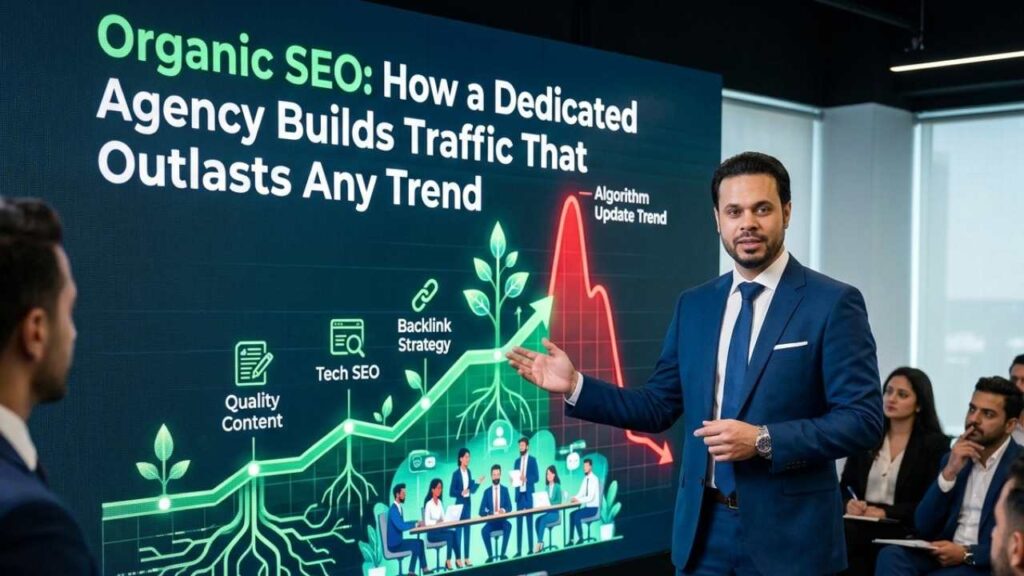
Organic SEO: How a Dedicated Agency Builds Traffic That Outlasts Any Trend
Pure white-hat organic search that compounds month after month — no ad budget required, no shortcuts, no penalties.
An Organic SEO Agency is a specialist firm that grows a website’s visibility in Google’s natural (non-paid) search results through content quality, technical excellence, and earned authority — not advertising spend. The traffic it produces is self-sustaining: once a page ranks, it keeps delivering clicks without a daily budget attached to it.
Most businesses reach a point where paid ads become a ceiling rather than an accelerator. CPC costs creep up, Quality Scores fluctuate, and the moment the campaign pauses, the traffic disappears entirely. Organic search works differently. A well-executed content and link strategy is an asset, not a recurring expense — and its value increases over time. If you’re wondering what might be blocking your organic traffic right now, the answer usually sits at the intersection of content gaps, authority deficits, and technical barriers that most generalist agencies never fully address.
JTC — Junaid Tariq Consulting — was built as a pure organic-first practice. Our work spans 48 countries, more than 100,000 keywords ranked globally, and long-term partnerships with major Pakistani and international brands. Everything on this page explains exactly how we approach organic SEO, what realistic timelines look like, and why the compounding returns from a disciplined strategy consistently outperform short-term traffic tactics. Explore our full SEO agency offering — beyond just organic if you need a broader picture of the services available.
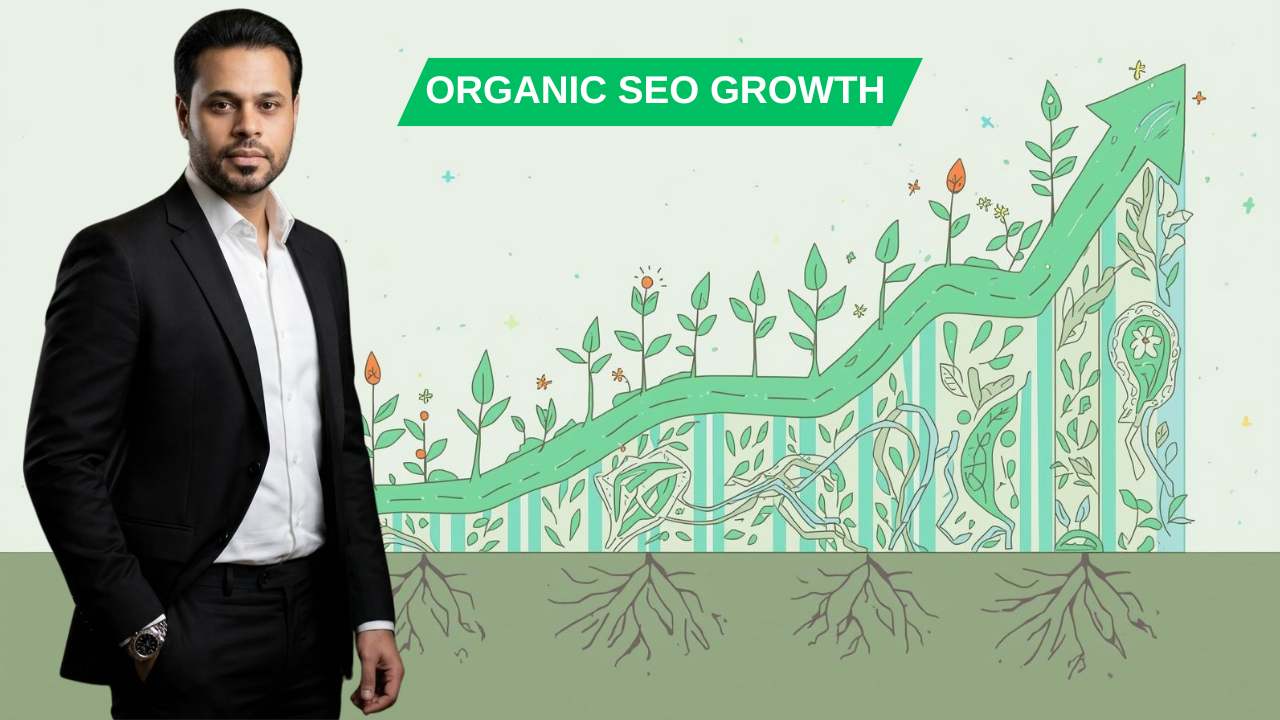
What Organic SEO Means — and Why It Consistently Outlasts Paid Traffic
Search engine optimisation is, at its core, the practice of making a website easier for search engines to understand, index, and recommend. The “organic” modifier means achieving this through merit — through content that genuinely answers searcher intent, through technical infrastructure that lets crawlers do their work, and through inbound links that signal authority — rather than through payments to Google or Bing.
The staying power of organic search is structural. When you stop running ads, traffic stops. When you have a page ranking organically on page one for a commercially valuable keyword, that page continues delivering visitors 24 hours a day, seven days a week, without a billing cycle attached. Research consistently shows that organic listings capture the majority of clicks — particularly in industries where buyers do extended research before committing. A single well-ranking product or service page can replace the output of a paid search campaign that costs tens of thousands of rupees per month.
There is also the matter of credibility. Users inherently trust organic results more than ads. High organic placement signals to a searcher that Google has evaluated the page and found it to be one of the best answers available — a form of third-party endorsement that no amount of ad spend can replicate. For businesses in competitive Pakistani markets or targeting international audiences, that perception difference is commercially significant.
Organic Search Experts vs PPC Specialists: Completely Different Skill Sets, Different Results
The skills required to run a profitable Google Ads campaign are largely financial and analytical: bid management, audience segmentation, landing page conversion rate, Quality Score optimisation. PPC specialists are outstanding at what they do — and there are situations where how paid ads complement organic search for faster early wins is a conversation worth having. But those skills transfer poorly to organic work.
Organic Search Experts work in a fundamentally different discipline. They need to understand how search crawlers interpret HTML structure. They need to diagnose why a page with good content is losing rankings to a competitor with weaker prose but a stronger internal linking architecture. They need to know what a natural link profile looks like versus one that will flag a manual review. They read Core Update documentation, study entity-based search, and think in terms of topical authority clusters — not just individual keywords.
When a business hires a generalist agency and expects their PPC team to handle organic search, the results are predictable: surface-level optimisation, templated blog posts, and eventually a plateau. True organic work requires specialists whose entire professional development is focused on natural search — people who think about crawl budget at 8am and semantic keyword proximity at 8pm.
Key Insight: According to research aggregated by Backlinko’s SEO hub, the #1 result in Google receives roughly 10 times more clicks than the #10 result on the same page. The difference between position five and position one is not incremental — it is exponential.
How an Organic SEO Agency Builds Traffic Without Ongoing Ad Spend
The mechanism is straightforward in principle, complex in execution. An organic SEO agency builds ranking equity through three coordinated channels: content that satisfies search intent better than competing pages, technical infrastructure that lets crawlers access and understand that content efficiently, and earned links from external websites that transfer authority. None of these requires a payment to Google. All of them require sustained professional work.
What distinguishes a professional agency from a business attempting SEO in-house is depth and breadth of execution. A solo marketing manager can publish a blog post. A dedicated agency identifies the exact semantic structure that will earn a featured snippet, maps internal links to pass PageRank to the page that needs it most, and simultaneously builds editorial relationships that result in authoritative backlinks — all in the same month.
The other critical advantage of an organic-first agency is continuity. SEO knowledge compounds within a team. An analyst who has managed your crawl logs for 12 months understands your site architecture, your competitive landscape, and your content gaps in a way that cannot be replicated by switching vendors. The relationship between the agency and the client site is an appreciating asset in itself.
The Organic SEO Approach: Quality Content, Earned Links, and Technical Excellence
Moz’s SEO learning centre describes the three pillars of modern organic optimisation as relevance, authority, and experience. That framework maps well onto how a serious agency approaches a new engagement:
- ■
Content relevance — Every page must answer a clearly defined search intent better than the competing pages currently ranking. This is not about keyword density; it is about semantic completeness, structured data, and entity coverage. - ■
Domain and page authority — Earned backlinks from credible, thematically relevant websites remain one of the strongest signals in Google’s ranking algorithm. Earning them requires creating content or resources that other sites genuinely want to reference. - ■
Technical SEO and user experience — Page speed, Core Web Vitals, mobile usability, crawl efficiency, structured markup, and logical site architecture. These are the foundations that content and links are built upon. Without them, even excellent content underperforms. - ■
White-hat methodology — Every tactic used must comply with Google’s Webmaster Guidelines. No link schemes, no hidden text, no manipulative redirects. Tactics that appear to work quickly at the cost of long-term risk are not a trade-off we make for any client.
What Organic SEO Specialists Do Month by Month — the Real Workflow
One of the most persistent misconceptions about organic SEO is that it is a one-time project: optimise the site, then wait. In reality, Organic SEO Specialists operate on a continuous improvement cycle. Here is what a typical monthly workflow actually looks like inside a professional engagement:
Activity |
Frequency |
Why It Matters |
|---|---|---|
Crawl health audit |
Monthly |
Catches new technical issues before they impact rankings |
Keyword ranking review |
Weekly |
Identifies rising opportunities and pages losing ground |
Content publishing / optimisation |
2–4× per month |
Expands topical authority and targets new keyword clusters |
Link acquisition outreach |
Ongoing |
Builds domain authority through earned editorial placements |
Competitor gap analysis |
Monthly |
Finds keywords your competitors rank for that you don’t yet |
Internal link architecture review |
Quarterly |
Redistributes PageRank to priority pages efficiently |
Performance reporting |
Monthly |
Tracks organic sessions, conversions, and keyword position movement |
The output of this workflow is not just a spreadsheet of rankings. It is a growing body of optimised content, a strengthening link profile, and a technically sound website that earns more visibility with each passing month — compounding in a way that no ad campaign can replicate.
How Organic SEO Consultants Build a Long-Term Strategy That Compounds
Organic SEO Consultants at the senior level operate differently from execution-focused specialists. Their primary function is strategy architecture: determining which keyword clusters represent the highest ROI opportunity, which content formats are most likely to earn links and answer featured snippet queries, and how the site’s authority should be built over a 12 to 24-month horizon.
A strong consultant does not just chase volume. They map keyword difficulty against commercial intent against topical authority. A 10,000-search-per-month keyword that a brand new site cannot realistically rank for in 12 months is worth less than a 1,200-search-per-month keyword with high transactional intent that the same site can reach page one for within six months. Strategy is about sequencing: building the authority base that unlocks the higher-competition targets over time.
This is precisely why businesses looking for why Pakistani businesses are choosing organic SEO — and moving away from pure paid acquisition — consistently cite strategic depth as the distinguishing factor. An experienced consultant who has managed campaigns across diverse markets brings pattern recognition that data alone cannot provide.
Organic SEO Timeline: The Realistic Growth Curve from Month 1 to Month 12
One of the areas where competitor content consistently fails readers is the timeline question. Most pages either give an unhelpfully vague “3 to 6 months” or gloss over it entirely. Here is an honest breakdown of what a well-executed organic SEO engagement typically looks like, and why:
Months 1–2: Foundation and Audit
Technical audit, keyword research, competitor gap analysis, content gap mapping, crawl issue resolution, Core Web Vitals baseline. Very little visible ranking movement at this stage — but everything that follows depends on this work being done correctly. Sites with significant technical debt can take the full two months here.
Months 3–4: Early Signals
Google Search Console begins to show new impressions for targeted keywords. Early-stage long-tail keywords — lower competition, high intent — start entering the top 20. Content publishing begins contributing to topical authority. First link acquisitions start building domain equity. Most clients see modest but measurable organic session growth in month four.
Months 5–8: Momentum
Mid-competition keywords begin moving into the top 10. The content volume now forms topical clusters that reinforce each other. Pages published in months 1 to 3 are maturing in authority. Monthly organic sessions typically double or triple from the baseline by month 7 in most campaigns. This is the phase where the ROI conversation becomes very clear.
Months 9–12: Compounding Returns
High-competition primary keywords reach page one. Existing rankings continue generating new inbound links organically. Content published early in the campaign now ranks for dozens of secondary and semantic keyword variants beyond what was originally targeted. The organic channel begins contributing a consistent, growing share of total revenue. You can see specific organic growth results from real client campaigns in our case study library.
Compounding Returns: Why Organic Traffic Keeps Growing After Year One
The most under-discussed advantage of sustainable SEO is what happens after the first year. Paid traffic is linear — you spend X and receive Y clicks. Organic growth is exponential because authority compounds. A high-authority page that ranks for a primary keyword starts earning links from other sites that want to cite it. Those links lift other pages on the same domain. Those pages rank for new keywords, which attract more content referencing the site, which builds more authority — and so the cycle accelerates.
This is compound organic growth: the same mechanism that makes long-term financial investment so powerful, applied to digital visibility. A business that begins serious organic SEO investment today will find that the cost per acquired organic visit in year three is a fraction of what it was in year one — while the volume of visits continues climbing. No paid channel works this way.
Expert Insight: Businesses that treat organic SEO as a long-term capital investment — rather than a monthly service expense — consistently achieve lower customer acquisition costs and higher lifetime value from their inbound channel. The patience required in months 1 to 4 is repaid many times over in years 2 and 3.
The Content-Link Loop: How the Best Organic SEO Agencies Earn Top Rankings
The most durable ranking mechanism in organic search is a loop, not a one-off action. The loop works like this: exceptional content earns unprompted backlinks from other websites, which increases domain and page authority, which improves rankings for that content, which exposes it to more readers, a percentage of whom link to it further. The agency’s job is to ignite this loop and sustain it by consistently producing content worth linking to.
The types of content that earn natural links include original research and data studies, definitive guides that outrank existing resources in comprehensiveness, tools and calculators that solve recurring problems, and case studies with specific, verifiable results. Creating any of these takes genuine investment — but the link equity they accumulate over years of organic discovery makes them among the highest-ROI assets in a marketing budget.
In parallel with earned links, outreach-based link acquisition fills the gap in the early stages of a campaign when organic link earning hasn’t yet scaled. Done correctly — with relevance and editorial value as the guiding criteria — outreach-earned links are entirely white-hat organic SEO and contribute meaningfully to authority building without any risk of penalty.
Our White-Hat Guarantee: What We Will and Won’t Do for Your Rankings
White-hat organic SEO is not just an ethical position — it is a commercial one. Google’s ability to detect and penalise manipulative tactics has improved dramatically over the past decade. Techniques that produced quick results in 2014 are now a direct path to manual penalties, algorithmic suppression, and in extreme cases, complete deindexation. The recovery cost from a penalty typically exceeds years of the investment that was supposedly being saved.
At JTC, our guarantee is explicit:
- ■
We will: build content that genuinely earns its rankings through quality and relevance - ■
We will: acquire links only through editorial merit and contextual relevance - ■
We will: be transparent about timelines and report results without inflating vanity metrics - ■
We will not: use private blog networks, paid link schemes, or cloaking - ■
We will not: promise page-one rankings within 30 days for competitive keywords - ■
We will not: take actions that could expose your domain to a future penalty
Case Study: Pakistan Business That Grew from Zero Organic Traffic to 8,000 Monthly Visits
A mid-sized Pakistani e-commerce business approached JTC with a site that had been live for two years but was generating fewer than 80 organic sessions per month. The site had no penalty, reasonable content, and a functional product catalogue — but it ranked for almost nothing. The root causes were a combination of technical indexation failures, near-zero domain authority, and a content strategy that had produced isolated blog posts without topical cohesion.
The Approach
Month one was entirely technical: canonical tag restructuring, crawl budget optimisation, elimination of duplicate content, and a full Core Web Vitals remediation. Month two introduced a 12-month content plan built around four topical authority clusters. Each cluster was anchored by a comprehensive pillar page supported by eight to ten satellite articles targeting semantically related long-tail queries.
The Results
By month five, organic traffic had grown to approximately 1,200 monthly sessions — a 15× increase from the 80-session baseline. By month nine, the site was generating over 4,500 monthly organic sessions and ranking on page one for 23 primary commercial keywords. At the 12-month mark, monthly organic visits had reached 8,000 with 61 page-one keyword rankings and organic search representing 38% of total site revenue. The budget invested was a fraction of what an equivalent paid search campaign would have required to generate the same traffic volume.
This is the trajectory that natural search, properly executed, creates — and it applies to businesses across sectors, markets, and sizes.
Why Clients Trust JTC with Their Organic Growth
Harvard & Google Certified
Globally Across All Niches
International Search Campaigns
PTCL · Stylo · Rozee · RDX · Orient
Frequently Asked Questions
Q: What exactly does an organic SEO agency do?
An organic SEO agency improves a website’s visibility in Google’s non-paid (organic) search results by combining technical optimisation, content strategy, and link acquisition. Unlike paid advertising, the traffic produced is self-sustaining: once pages earn strong rankings, they continue delivering visitors without a recurring ad budget. The agency manages this process on an ongoing basis, adapting to algorithm changes and identifying new keyword opportunities as the campaign matures.
Q: How long does organic SEO take to show results?
Most businesses begin seeing measurable organic traffic growth between months three and five of a well-executed campaign. Significant ranking movement on competitive primary keywords typically happens between months six and ten. The variation depends on the site’s existing authority, the competitiveness of the target keyword set, and the technical health of the site at campaign launch. New domains take longer than established ones with some existing equity.
Q: How is organic SEO different from paid search?
Paid search (PPC) places your ad at the top of results for as long as you pay per click. Organic SEO earns natural rankings through content quality and authority — rankings that persist without ongoing payment. Paid delivers immediate traffic but stops the moment the budget runs out. Organic builds an asset: a library of ranked pages whose combined traffic grows over time and whose per-visit cost decreases as the campaign matures.
Q: What does “white-hat organic SEO” mean in practice?
White-hat SEO refers to tactics that comply with Google’s Webmaster Guidelines — earning rankings through content merit, technical quality, and genuinely acquired links rather than through manipulation. In practice, it means no purchased link schemes, no hidden text, no private blog networks, and no cloaking. It takes longer than black-hat shortcuts but produces rankings that survive algorithm updates rather than collapsing with them.
Q: Can a Pakistani business compete organically against international competitors?
Yes — and many do. Google’s algorithm is blind to geography when evaluating content quality and authority. A Pakistani business with a technically sound website, deep and well-structured content, and a growing backlink profile can outrank international competitors for commercially valuable search terms. Junaid Tariq has achieved page-one rankings for Pakistani clients in 48 countries, including competitive English-language markets, by applying the same organic principles that work everywhere.
Q: Is organic SEO worth the investment for small businesses?
For small businesses with limited ad budgets, organic SEO is often the highest-ROI marketing channel available. The initial investment is front-loaded, but the returns compound: a page that ranks on page one for a service keyword continues delivering leads every month without additional spend. Businesses that invest in organic SEO early build a competitive advantage that becomes harder for newer entrants to close over time.
Q: What makes JTC different from other organic SEO agencies?
JTC is led by Junaid Tariq, a Harvard and Google-certified SEO strategist with 18+ years of experience and a track record of ranking over 100,000 keywords across 48 countries. The agency is structured around organic-first work — not as a secondary service added to a PPC or social media offering, but as the core discipline. Every client receives strategy-level input from senior expertise rather than being handed to junior account managers after onboarding.
Q: What should I look for when hiring organic SEO consultants?
Prioritise verifiable case studies with specific before-and-after traffic and ranking data, transparency about methodology (they should be able to explain exactly what they’ll do and why), and a clear understanding of your industry’s search landscape. Be cautious of consultants who guarantee specific rankings on a fixed timeline or who cannot clearly explain their link acquisition process. The best organic SEO consultants will tell you honestly what is achievable given your site’s current authority and budget.
Q: How do organic SEO specialists measure success?
Serious organic SEO specialists track a hierarchy of metrics: organic session volume and trend, keyword position movement across primary and secondary targets, organic-attributed conversions and revenue, backlink profile growth (domain rating and referring domain count), and Core Web Vitals scores. Rankings alone are a leading indicator — the ultimate measure of success is whether organic search is generating qualified traffic that converts into business outcomes.
Q: Do I still need organic SEO if I’m already running paid ads?
Paid and organic search serve complementary but distinct roles. Paid ads deliver immediate visibility for high-intent queries and are particularly effective while an organic campaign is building momentum. But they have a ceiling: rising CPCs, ad fatigue, and the complete loss of traffic when budgets pause. Businesses that run both channels find that organic SEO reduces their long-term cost per acquisition while paid ads capture demand that organic hasn’t yet reached. The goal is a decreasing dependency on paid over time as the organic asset matures.