
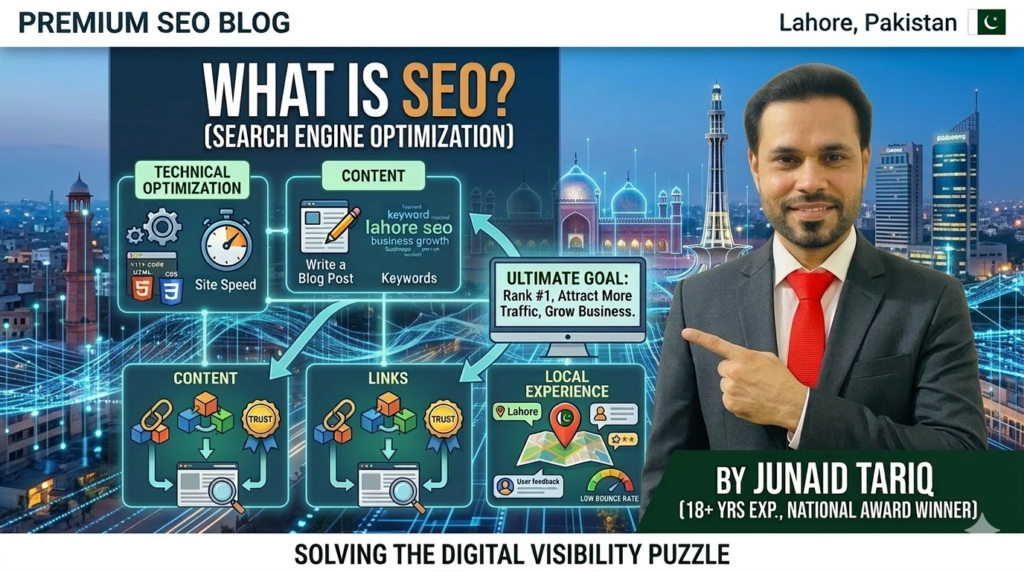

What is SEO? The Answer Every
Business Owner Needs
From how Google actually works to what SEO costs, timelines, types, and common traps — everything a business owner needs before spending a single pound on search visibility.
The Invisible Customer Problem
There is a dental practice two streets from yours. Same services, similar prices, roughly the same number of chairs. Last month, you booked 90 new patients. They booked 430. You're not worse at dentistry. You're not cheaper. You're not more conveniently located. The only meaningful difference is that when someone in your city searches "dentist near me" or "Invisalign cost," they appear. You don't.
That gap — the gap between the business that shows up and the business that doesn't — is what SEO creates and what the absence of SEO destroys. And the maths are unforgiving. If each new patient is worth £400 over their lifetime, that visibility gap costs you roughly £136,000 in annual patient value. Not because you're doing anything wrong. Because you're invisible.
Search Engine Optimisation (SEO) is the practice of improving a website's visibility in organic (unpaid) search engine results so that the right people — people actively searching for what you offer — can find you. That's the definition you can repeat to anyone. No jargon, no acronyms, no technical prerequisites.
That last number is the one that matters. Page two of Google is, in practical terms, invisible. If your business isn't on page one — ideally in the top three results — for the searches your customers are making, you're not losing some traffic. You're losing almost all of it.
SEO isn't a marketing luxury for big companies. It's the mechanism by which customers who are already looking for your product or service either find you or find your competitor. It works while you sleep, while you're with a client, while you're on holiday. Done properly, it compounds over time — unlike paid advertising, which stops delivering the moment you stop paying for it. The documented outcomes from real SEO campaigns consistently show that organic traffic delivers a higher return on investment than almost any other digital channel over a 12–24 month window.
The rest of this article will walk you through exactly how SEO works, what the different types are, how long it takes, what it costs, what not to do, and what the most significant changes coming to search in 2025 and 2026 mean for your business. By the end of it, you'll be able to make genuinely informed decisions — whether you decide to do it yourself, hire in-house, or bring in outside expertise.
30 Years of Search: From Keyword Stuffing to AI
To understand why SEO works the way it does today, you need at least a basic understanding of where it came from. Because the rules didn't appear from nowhere — they were written in direct response to people trying to break them.
The first search engines emerged in the early 1990s. Archie (1990), Gopher, and AltaVista were essentially directories — indexes of web content organised mostly by keyword density. If you used a word ten times on a page, you ranked higher for that word than someone who used it twice. This led to the practice known as keyword stuffing: filling pages with invisible text, hiding keywords in white fonts on white backgrounds, and building pages designed entirely for machines rather than readers.
Then Google arrived in 1998 with a fundamentally different idea — that the quality of a page could be inferred not just from its content, but from who was linking to it. PageRank (the algorithm named after co-founder Larry Page) treated inbound links as votes of confidence. A page linked to by many other credible pages must be credible itself. This was a paradigm shift. It moved the signal from what you said about yourself to what others said about you.
What followed was 25 years of Google systematically closing every loophole that marketers found and exploited. Here is how that history maps to real business outcomes:
"The lesson from 30 years of search evolution is consistent — Google always moves toward rewarding what is genuinely useful for the person searching."
The throughline of every major algorithm update, 1998–2025This history matters practically. It tells you that short-cuts have a shelf life, and the businesses that invested in genuine quality rather than gaming the system are the ones that have compounded rankings over years rather than rebuilt from scratch every time a major update rolled out.
How Search Engines Actually Work
Think of Google as the world's most rigorous restaurant critic. Every day, thousands of new restaurants open, and every restaurant wants the critic to feature them in the "best restaurants in your city" list. The critic can't personally visit every one — so they send scouts. The scouts explore, take notes, and report back. Then the critic decides, based on everything the scouts found plus their own knowledge of what diners actually want, which restaurants deserve to be recommended and in what order.
In SEO, those scouts are called crawlers (or bots). Google's crawler, Googlebot, travels continuously across the internet — following links from page to page, reading content, and reporting back to Google's servers. This is called crawling.
The notes Googlebot takes are stored in Google's index — a library of billions of web pages. When you search for something, Google isn't searching the live internet. It's searching its index of the internet, which is why results appear in under a second. If your page isn't in the index, it doesn't exist as far as Google is concerned. If it is indexed but poorly understood, it won't rank well.
The third step is ranking — Google's algorithm deciding, from all the pages in its index that are relevant to your search, which ones to show first. This is where the complexity lives. Google uses over 200 ranking factors, but they broadly cluster into three areas:
- Relevance — Does this page actually answer the query? Does it cover the topic with sufficient depth? Is the content written for a human reader who needs this information?
- Authority — How much does the rest of the internet trust this page? How many credible websites link to it? How established is the domain?
- Experience — When someone lands on this page, do they stay and find what they needed? Is it fast? Does it work on mobile? Is it easy to navigate?
Understanding Search Intent
One of the most important things Google has become sophisticated at is identifying search intent — what someone is actually trying to accomplish when they type a query. There are four types, and matching your content to the correct intent is non-negotiable for ranking:
Intent Type |
What the User Wants |
Example Query |
Business Implication |
|---|---|---|---|
Informational |
Learn something |
"what is SEO" |
Educational content; establishes authority; top of funnel |
Navigational |
Go to a specific place |
"Junaid Tariq consulting" |
Brand health; ensure your homepage ranks for your own name |
Commercial Investigation |
Compare options before deciding |
"best SEO agency Lahore" |
Comparison content, reviews, case studies |
Transactional |
Take action right now |
"hire SEO consultant" |
Direct service pages with clear CTAs; highest conversion intent |
A page optimised for transactional intent ("hire SEO consultant") will not rank for informational queries ("what is SEO") and vice versa — because the intent is different. Google knows what each type of searcher wants, and it shows them content that matches. Getting the intent wrong is one of the most common and expensive mistakes in content strategy.
The AI Layer: RankBrain and Beyond
Since 2015, Google has used machine learning systems — starting with RankBrain and evolving through BERT and MUM — to handle ambiguous queries and understand meaning beyond literal keywords. What this means for businesses is that writing naturally about a topic in depth now outperforms trying to optimise for specific keyword strings. Google understands context, synonyms, and related entities. If you write a genuinely comprehensive page about "dental implants" in your city, it will naturally rank for dozens of related queries you never explicitly targeted. For professionally delivered expert SEO services that build this kind of topical depth, the results compound significantly faster than DIY efforts.
Google holds roughly 91.5% of global search market share (Statista, 2024), making it the only search engine that truly requires a primary strategy. However, Bing maintains meaningful share among specific demographics — particularly older professionals and corporate Windows users whose browsers default to Bing — and is worth including in any complete strategy.
The Six Types of SEO: What Each One Does and Why It Matters
When people say "SEO," they're usually collapsing six distinct disciplines into a single word. Understanding each one helps you diagnose where a problem actually lives — and avoid spending money on the wrong solution.
On-Page SEO
Everything visible on and within your page: title tags, headings, body content, image alt text, internal links, URL structure. This is the most directly controllable element of SEO.
Off-Page SEO
What the rest of the internet says about you. Primarily backlinks, but also brand mentions, social signals, and your online reputation. You influence it but don't fully control it.
Technical SEO
The infrastructure your content sits on: site speed, mobile-friendliness, crawlability, HTTPS, XML sitemaps, structured data. Invisible to users but foundational to rankings.
Local SEO
Visibility in location-based searches and the Google Map Pack. Critical for any business with a physical location or service area. The most immediate ROI channel for local businesses.
On-Page SEO: You Control This Completely
On-page SEO starts with the title tag — the clickable headline that appears in search results. It should include your primary keyword naturally, within 60 characters. Your meta description (the grey text beneath the title in results) won't affect rankings directly but heavily influences whether someone clicks. A compelling meta description is copywriting, not technical SEO.
Beyond these, on-page SEO covers heading hierarchy (H1, H2, H3 — think of them as the chapter structure of your page), internal linking (connecting related pages within your own site to distribute authority and guide readers deeper), and content quality. A local accountancy firm writing genuinely useful content on "how to prepare your first VAT return" will rank for that query because their content serves the intent — not because they've engineered keyword density to a precise percentage.
Off-Page SEO: What Others Say About You
Backlinks remain the strongest off-page signal. A link from the BBC, a trade association, or a major industry publication carries far more weight than a link from a directory no one visits. Link building — the practice of earning these inbound links — is often the most difficult and most valuable part of SEO. The legitimate approach involves creating content worth linking to (original research, data studies, definitive guides), building relationships with journalists and industry publishers, and occasionally being featured in press coverage.
The shortcut approach — buying links, joining link farms, or using private blog networks — carries an increasingly high risk of Google penalties. Businesses that invested in shortcuts in 2018–2022 have spent the years since trying to recover the rankings they lost when Google caught up.
Technical SEO: The Foundation Everything Else Depends On
Technical SEO is the least visible but most foundational layer. If Google can't crawl your pages, it can't index them. If it can't index them, your content doesn't rank regardless of how good it is. Common technical issues include slow page loading (a page that takes four seconds to load loses approximately 25% of visitors before it finishes loading), duplicate content issues, broken links, improper canonical tags, and poorly structured XML sitemaps.
For businesses whose websites have been built quickly or cheaply, technical issues are frequently the primary barrier to ranking. A professional website structure and technical foundation built with search in mind from the start avoids months of retroactive fixing.
Local SEO: The Most Immediate ROI for Physical Businesses
Local SEO is the discipline of appearing in geographically-bounded searches: "dentist near me," "plumber Lahore," "best restaurant Gulberg." The centrepiece is the Google Business Profile — the listing that appears in the Map Pack (the three businesses shown in a box above organic results on local queries). Appearing in the Map Pack receives three times more clicks than the organic result directly below it. For service businesses, restaurants, clinics, and retailers, it's the highest-leverage single investment in local digital visibility.
A complete local SEO strategy covers Google Business Profile optimisation, NAP consistency (your business Name, Address and Phone number appearing identically across every directory and listing), local citation building, and generating a consistent flow of genuine customer reviews. Reviews aren't just social proof — they're a direct ranking signal. A business with 200 recent, detailed reviews will almost always outrank an equivalent business with 15.
E-commerce SEO and International SEO
E-commerce SEO introduces unique challenges: millions of product pages, faceted navigation creating duplicate content, and competition with Amazon for product keywords. For online retailers, the priority is almost always product page optimisation, site architecture (helping Google understand your category structure), and schema markup that gets your product listing into rich results with price and review stars visible directly in search.
International SEO applies when you're targeting multiple countries or languages — using hreflang tags to tell Google which version of your content is intended for which audience, and creating genuinely localised content rather than just machine-translated pages.
SEO Type |
What You Control |
What It Affects |
Time to Impact |
|---|---|---|---|
On-Page |
Fully — content, tags, structure |
Relevance signals, click-through rate |
2–6 weeks |
Off-Page |
Indirectly — content quality attracts links |
Domain authority, competitive ranking positions |
3–12 months |
Technical |
Fully — with developer access |
Crawling, indexing, page experience scores |
4–8 weeks post-fix |
Local |
Mostly — GBP profile, reviews, citations |
Map Pack visibility, local query rankings |
4–12 weeks |
The Key Elements of Effective SEO
Keyword Research: The Art of Understanding Intent
Keyword research is the process of identifying exactly what your target customers are searching for, how often, and with what intent. The most common mistake is targeting the most obvious keywords. A plumber doesn't want to rank for "plumbing" — they want to rank for "emergency plumber Manchester open now." The difference isn't just specificity; it's intent. Someone searching the second query has a burst pipe. They're calling the first result they find. The conversion rate is close to 100%. The conversion rate on "plumbing" as a query could be close to 0% — because the searcher might be a student doing homework.
Long-tail keywords — longer, more specific phrases — have lower search volume but dramatically higher conversion rates and lower competition. According to Ahrefs data, approximately 92% of all search queries receive fewer than 10 monthly searches. The market for specific, intent-driven searches is vastly larger than the market for broad, generic terms — and most businesses aren't competing for it at all.
Content Optimisation and E-E-A-T
Google's E-E-A-T framework stands for Experience, Expertise, Authoritativeness, and Trustworthiness. It's the criteria Google's quality raters use to assess whether content is genuinely useful. But what does it mean practically for a business?
"Think of Google as a trusted friend making a referral. When you ask a friend to recommend a plumber, they recommend the one with real experience on the job, visible qualifications on the wall, a strong word-of-mouth reputation in the neighbourhood, and reviews you can actually verify. They don't recommend the person who simply claims to be the best plumber. E-E-A-T is Google applying that same referral logic algorithmically — at scale."
The practical business interpretation of E-E-A-TFor a medical clinic, E-E-A-T means content reviewed by qualified clinicians, author credentials displayed, clinical sources cited, and a clear About page establishing the practice's background. For a solicitor's firm, it means case outcomes, professional body memberships, and an authorship trail that Google can verify. The author of a legal article on your website should be identifiable as a practising solicitor — not an anonymous "content team." After auditing hundreds of business websites over nearly two decades, the single most common gap I find is the absence of credible author attribution. Content with no identifiable author signals nothing to Google — no experience, no expertise, no trust.
Core Web Vitals: The User Experience Ranking Factors
In 2021 Google began using a set of measurable user experience signals — Core Web Vitals — as ranking factors. There are three:
- Largest Contentful Paint (LCP) — How long does the main content of your page take to appear? Google's threshold is under 2.5 seconds. Slower than 4 seconds is a poor score. A slow LCP typically means visitors are staring at a loading screen and leaving.
- Interaction to Next Paint (INP) — How quickly does your page respond to user interaction? A button that takes 500ms to respond after a click feels broken, even if it technically works.
- Cumulative Layout Shift (CLS) — Does the page content jump around while loading? A high CLS score means elements are moving as the page renders — the reader goes to click something and the page shifts, causing accidental clicks and frustration.
According to a 2023 HubSpot study, 82% of marketers report that website performance directly impacts conversion rates. Sites failing Core Web Vitals benchmarks typically lose rankings on competitive terms — not dramatically, but consistently — over months. Fixing them often produces ranking improvements without any additional content work.
Backlinks and Authority
Position 1 in Google typically has 3.8× more backlinks than positions 2–10, according to Moz's analysis of ranking correlations. Building domain authority requires earning links from genuinely credible external sources. The most sustainable method is creating content that other websites want to reference: original research with novel data, comprehensive guides, tools, or analysis that fills a genuine gap.
The metrics worth understanding are Domain Authority (DA) — a Moz score predicting how likely a domain is to rank — and Domain Rating (DR), Ahrefs' equivalent. Neither is a Google metric (Google doesn't publish its own domain authority score), but both correlate reasonably well with how competitive a site is in search. A new business website starting from zero authority is, all else being equal, a less competitive site than one that has been accumulating links for five years. Closing that gap requires time or investment, usually both.
How Click-Through Rates Vary by Position
One of the most useful pieces of data for understanding why rankings matter is CTR data by search position. According to Advanced Web Ranking's 2024 CTR study:
Position | Average CTR (Desktop) | Average CTR (Mobile) | What It Means |
|---|---|---|---|
#1 | 27.6% | 24.8% | Receives more clicks than positions 2–10 combined |
#2 | 14.8% | 11.2% | Still valuable but roughly half the volume of #1 |
#3 | 9.5% | 7.9% | Third place receives less than a third of #1's clicks |
#4–5 | 4–6% | 3–5% | Meaningful traffic, but requires high volume keywords to justify investment |
#6–10 | 1–3% | 1–2% | Marginal traffic; page one but practically invisible |
Page 2+ | <1% | <1% | Effectively zero. The business equivalent of not ranking. |
These numbers are why the goal isn't "page one" — it's top three. And why converting organic traffic into qualified leads requires not just visibility but the right content for searchers at each stage of their decision journey.
Best Practices, White-Hat SEO, and the SEO vs PPC Question
White-Hat vs Black-Hat: The Short Version
White-hat SEO is the practice of improving search visibility by genuinely improving your website and its content — making it faster, more useful, better structured, and more credible. Black-hat SEO is the practice of manipulating ranking signals through shortcuts: buying links, hiding text, cloaking content (showing Google a different page than users see), or building networks of fake websites to create artificial authority.
The gap between white-hat and black-hat hasn't narrowed — it has widened. Black-hat tactics that worked in 2015 produce penalties in 2025. The risk is asymmetric: potential short-term ranking gains versus the potential loss of your entire domain's authority and months of work. For a business rather than an SEO experimenter, the answer is straightforward. Build something real.
Content Strategy: The Engine of Organic Growth
The highest-performing long-term SEO strategy is a topic cluster model: one comprehensive pillar page covering a broad topic in depth, supported by a set of cluster pages covering specific subtopics in detail, all internally linked. This structure signals to Google that your website has comprehensive, authoritative coverage of a subject area — not just individual pages. HubSpot's growth from 50,000 to 4 million monthly organic visitors is the most cited example of this approach executed at scale over a sustained period.
For WordPress users, plugins like Yoast SEO or Rank Math provide a practical framework for on-page optimisation — checking title tag lengths, meta descriptions, keyword usage, and readability. These are tools for implementation, not strategy. The strategy — which keywords to target, which topics to own, how to position against competitors — requires human judgment that no plugin provides.
The SEO vs PPC Question Every Business Owner Asks
The most common version of this question is: "Why invest in SEO when I can just run Google Ads and appear immediately?" It's a fair question and deserves an honest answer — not a sales pitch for either channel.
SEO — Organic Search
PPC — Paid Advertising
The honest answer is that SEO and paid search advertising are not competing choices — they're complementary channels that serve different timeframes and different funnel stages. Businesses that run PPC while building organic rankings are covering two surfaces simultaneously. Those that run only PPC are renting visibility. Those that do only SEO are waiting 6–12 months for the first meaningful results while getting nothing in the interim.
The optimal strategy is to run targeted PPC campaigns on your highest-value keywords while building the organic presence that will eventually make those campaigns optional rather than essential. Social media marketing contributes to this through brand awareness and audience building — while social signals aren't a direct ranking factor, brand search volume (people searching for your name) is, and social activity drives brand awareness that translates into organic branded searches.
The Mistakes That Kill SEO Results
Keyword Stuffing: A Habit Google Has Specifically Learned to Penalise
Keyword stuffing is the practice of repeating a target keyword unnaturally throughout a page — often to hit a specific keyword density percentage. It was a genuine tactic in 2005. In 2025 it actively harms rankings by producing content that reads poorly, receives high bounce rates (which Google interprets as a quality signal), and directly triggers Panda-type content quality penalties. The alternative is simple: write naturally about your topic in depth. If the topic is relevant to a keyword, the keyword will appear naturally at an appropriate frequency.
Ignoring Mobile Experience and Speed
Google moved to mobile-first indexing in 2019, meaning it primarily evaluates the mobile version of your site for ranking purposes. A site that looks beautiful on a desktop but is slow, cramped, or confusing on a phone is being evaluated primarily on the phone experience. The cost is measurable: a one-second delay in mobile page load time reduces conversions by 20%, according to a Google/Deloitte study. Businesses that haven't audited their site's mobile performance recently are almost certainly losing rankings and customers simultaneously.
Buying Links: The Risk Is No Longer Theoretical
People buy links because they work — until they don't. Google's ability to detect unnatural link patterns has improved dramatically, and the Penguin algorithm update (now baked permanently into Google's core algorithm) processes link quality signals in real time. A link scheme that improves rankings for 18 months can result in a manual penalty that removes a website from Google's index entirely. Recovering from a manual link penalty typically takes 6–18 months and requires disavowing hundreds or thousands of purchased links. The actual cost of a link-building shortcut, calculated over the recovery period, almost always exceeds the cost of legitimate link building.
Stopping Too Early Because of Misread Data
Many businesses invest in SEO for three months, open Google Analytics, see no dramatic change in traffic, and conclude that SEO "doesn't work" for their industry. The problem is almost never the SEO — it's the timeline expectation and the measurement framework. Google typically takes 4–6 months to fully process and rank new content, and domain authority increases are slow and non-linear. The metric to track in the first 6 months isn't traffic — it's ranking progress on target keywords, index coverage, and technical health scores. Traffic follows ranking. Ranking takes time. Stopping at month three because traffic hasn't moved is the equivalent of pulling up a garden at the end of winter because nothing is flowering yet. What to do instead: measure the right leading indicators and set timeline expectations before you start, not during.
Ignoring Voice Search and Conversational Queries
With approximately 27% of global internet users using voice search on mobile (SparkToro, 2023), optimising exclusively for text-typed queries means missing a growing share of the market. Voice searches are typically conversational, longer, and question-based: "What's the best Italian restaurant near me that's open right now?" rather than "Italian restaurant open now." Featured snippet optimisation — structuring your content so that it directly answers questions in a format Google can read aloud — captures both voice and zero-click search results.
SEO Tools Worth Knowing
The tools available for SEO range from completely free to $500/month, from beginner-friendly to deeply technical. Here's an honest overview of what each is genuinely useful for:
Tool |
Cost |
Best For |
Skill Level |
|---|---|---|---|
Google Search Console |
Free |
Seeing which queries your site ranks for, identifying indexing issues, monitoring Core Web Vitals |
Beginner |
Google Analytics 4 |
Free |
Understanding where your traffic comes from, what users do on your site, and conversion tracking |
Beginner–Intermediate |
Google Keyword Planner |
Free (with Ads account) |
Discovering keyword search volumes and finding related search terms |
Beginner |
Ahrefs |
$99–$399/month |
Backlink analysis, competitor research, keyword difficulty, content gap identification |
Intermediate–Advanced |
SEMrush |
$120–$450/month |
Full-suite SEO + PPC + competitor intelligence; particularly strong for content marketing |
Intermediate–Advanced |
Moz Pro |
$99–$299/month |
Domain Authority tracking, local SEO tools, site audits; strongest for beginners to intermediate |
Beginner–Intermediate |
Screaming Frog SEO Spider |
Free (up to 500 URLs) / £149/year |
Technical SEO audits — crawling a site to identify broken links, duplicate content, missing tags |
Intermediate–Advanced |
Surfer SEO / Clearscope |
$89–$200/month |
AI-assisted content optimisation — analysing top-ranking competitors to guide content depth |
Intermediate |
A note on AI content tools: Clearscope and Surfer SEO are genuinely useful for identifying semantic gaps in existing content — topics the top-ranking competitors cover that your page doesn't. They assist content strategy. They do not replace the judgment required to determine which topics to target, how to position against competitors, or how to structure a content programme around a business objective. For foundational learning, the Moz Beginner's Guide to SEO, Google's own Search Central documentation, and Search Engine Journal provide reliable, regularly updated guidance without product bias.
Measuring SEO Success: Real Metrics vs Vanity Metrics
The most common misunderstanding in SEO reporting is confusing ranking for measuring. A business owner who checks whether they appear on page one for a handful of keywords is doing a vanity check — not measurement. Meaningful SEO measurement tracks organic traffic volume, lead quality from organic search, conversion rates by landing page, and ultimately revenue attributable to organic channels.
The Honest SEO Timeline
The single most frequently asked question about SEO is also the one most vaguely answered. Here is the honest version, based on patterns across hundreds of campaigns:
Site Situation |
Time to First Meaningful Results |
What "Meaningful" Looks Like |
Key Variables |
|---|---|---|---|
New website, no authority, competitive niche |
9–18 months |
Ranking for long-tail terms, initial referral traffic, 500–2,000 monthly organic visits |
Content volume, link building investment, niche competition |
New website, low competition niche |
4–8 months |
Page one rankings for primary service terms, 300–1,500 monthly organic visits |
Content quality, on-page optimisation, local vs national scope |
Established site with technical issues |
6–12 weeks post-fix for recovery |
Recovery to pre-issue performance levels, then incremental growth |
Issue severity, indexing time after fix |
Local service business (Map Pack) |
6–16 weeks |
Top 3 Map Pack for primary service + location queries |
GBP completeness, review velocity, local citation consistency |
Highly competitive niche (legal, finance, insurance) |
12–24 months |
Page one for mid-competition terms; top 5 for lower-competition terms |
Domain authority vs competitors, content investment, link acquisition budget |
ROI: Making the Numbers Real
SEO ROI is calculated the same way as any other marketing channel investment. If your organic channel generates 80 qualified leads per month, and your average lead is worth £300 in gross margin over their lifetime, that's £24,000 per month in organic lead value. If your SEO investment is £2,500 per month, your ROI is approximately 860%. This is not a theoretical figure — it's the kind of return documented in the real-world ranking results from sustained SEO campaigns on competitive terms.
The calculation above is conservative and doesn't account for compounding — a site that ranks for 10 terms in month 12 typically ranks for 30–50 by month 24, as content depth and domain authority grow. The paid campaign generates exactly as much traffic as the budget allows, every month, with no compound effect.
The Future of SEO: What Actually Changes in 2025 and Beyond
There is a version of this section in almost every SEO article written in the past three years, and most of them say the same thing: "AI is transforming search." That's true, but it's not specific enough to be useful. Here's what it actually means for your business.
Google's AI Overviews: Not the Death of SEO, but a Raising of the Bar
Google's AI Overviews (previously SGE) generate summaries at the top of results pages for many informational queries. The first reaction from many businesses and marketers was alarm: if Google answers the question directly, why would anyone click through? The data is more nuanced. For queries with a clear, finite answer ("what year was Google founded"), AI Overviews do reduce clicks to individual websites. For complex, contextual queries ("how do I choose the right accountant for a growing business"), AI Overviews tend to increase engagement with cited sources — because the summary drives interest and the reader clicks through to learn more.
The practical implication is clear: if you are the most authoritative source in your niche, AI Overviews cite you. If you're not, they bypass you and cite someone else. The strategy for 2025 isn't to fight AI search — it's to be the source of record that AI search pulls from. That requires depth, accuracy, original data, and genuine expertise signal. Everything that has always constituted good SEO, executed at a higher standard.
Zero-Click Searches: Why Ranking Still Matters Even When Nobody Clicks
Approximately 50% of searches now end without a click — the user gets the answer from featured snippets, knowledge panels, or AI Overviews. For some businesses, this is genuinely disruptive. For most, it's a brand opportunity rather than a threat. When your content is featured in a snippet or AI overview, your brand name appears at the top of results even without a click. Multiple exposures to a trusted brand name in zero-click results drive branded search volume — and branded searches are among the strongest signals of audience intent. You're building familiarity that converts later, in different contexts.
Voice Search and Featured Snippets
Voice search queries are by nature question-based and conversational. Google's voice answers are pulled directly from featured snippets — the boxed answer that appears above organic results for many question-based queries. Structuring content to directly answer questions (using question-and-answer formats, clear definitional sentences, and concise factual paragraphs) captures both voice search and featured snippet placement. Both drive brand recall and, for commercial queries, direct traffic.
Privacy, First-Party Data, and the Cookieless Transition
The gradual phase-out of third-party cookies and Apple's App Tracking Transparency changes have reduced the precision of paid advertising targeting significantly. This makes organic search — which is inherently based on declared intent (the user types what they want) — relatively more valuable than before. A user who finds your site through organic search for "business accountant Lahore" has told you, without any tracking infrastructure, exactly what they need. That declared-intent traffic will only grow in importance as paid advertising targeting becomes less granular.
What to Do Today
The businesses that will rank well in 2026 and beyond are the ones building genuine topical authority now — creating comprehensive content around their subject areas, earning links from credible sources, maintaining technically sound websites, and consistently collecting customer reviews. The algorithm will keep changing. The underlying logic — reward what is genuinely useful — will not.
What to Do With All of This
Three things are worth holding onto from this article. First: SEO is not optional for most businesses — it's the mechanism by which customers who are already looking for what you offer either find you or find someone else. Second: it takes time, and the businesses that treat it as a long-term compounding investment consistently outperform those that treat it as a quick-win marketing tactic. Third: the fundamentals have been stable for over a decade. Quality, authority, and user experience have been the core signals since Google's early algorithm decisions. Every major update has moved further in that direction, not away from it.
If you're starting from zero, the priority sequence is: fix technical foundations first, then build content that matches genuine search intent in your market, then earn authority through legitimate means. If you're an established business that has neglected SEO, the most revealing first step is a thorough audit — understanding where your current gaps are before deciding how to address them.
The experience required to do this at a competitive level is significant. The frameworks are learnable; the judgment that comes from executing hundreds of campaigns across different industries and competitive landscapes takes years to develop. If you're evaluating whether to build that capability internally or bring in an experienced outside perspective for a free, no-obligation consultation — the right answer depends entirely on your competitive situation, your timelines, and your budget. What it doesn't depend on is whether SEO itself matters for your business. For almost every business with an online presence, it already does.
Not Sure Where to Start?
Get a no-obligation SEO assessment for your website — identifying your biggest opportunities and the clearest path to ranking in your market.
Request a Free SEO Audit →12 Questions Business Owners Ask About SEO
For a new website in a competitive niche, expect 9–18 months before meaningful organic traffic. Local businesses targeting Map Pack visibility typically see results in 6–16 weeks. Established sites fixing technical issues often recover in 6–12 weeks post-fix. Timeline depends heavily on competition, domain age, and content investment.
Yes — particularly local SEO, which often delivers the fastest ROI. A small business appearing in the Google Map Pack for local searches receives significantly more enquiries than one relying solely on paid ads. Organic traffic has no per-click cost once rankings are established, making it disproportionately valuable for businesses with limited advertising budgets.
SEO generates organic (unpaid) traffic through rankings that persist without ongoing spend. PPC (pay-per-click advertising) delivers immediate visibility at a cost per click — traffic stops when budget stops. SEO compounds over time; PPC is linear. Both are most effective when used together: PPC for immediate results while SEO builds long-term organic authority.
Professional SEO services typically range from £500–£5,000 per month depending on competitiveness, scope, and whether the work includes content creation and link building. Local SEO campaigns are generally on the lower end. National or international campaigns in competitive niches require higher investment. DIY SEO using free tools is possible but slower without strategic expertise.
Basic on-page SEO and local SEO fundamentals are learnable for motivated business owners. The Google Search Central documentation and Moz's Beginner's Guide are legitimate starting points. However, technical SEO, competitive link building, and developing a strategy that outranks established competitors typically requires experience that takes years to develop and tools that cost hundreds per month.
Local SEO is the practice of optimising your business's visibility in geographically-bounded searches — "dentist near me," "plumber Lahore," "coffee shop Gulberg." Any business with a physical location or defined service area needs local SEO. Appearing in the top three of Google's Map Pack generates significantly more enquiries than equivalent organic rankings below it.
Likely one or more of: older domain with more accumulated authority, more or better-quality backlinks, more comprehensive content on key topics, better technical performance, or more consistent Google Business Profile signals. A competitor analysis audit will identify precisely which gap is most responsible for the ranking difference and where the fastest improvement opportunity lies.
Google updates its core ranking algorithm thousands of times per year. Most are minor adjustments. Major updates — like the Helpful Content Updates of 2022–24 — can cause significant ranking changes for large numbers of websites. Businesses doing ethical, user-first SEO are rarely significantly harmed by major updates; businesses using manipulative tactics are most at risk.
E-E-A-T stands for Experience, Expertise, Authoritativeness, and Trustworthiness. Google uses it to assess whether content is genuinely useful and credible — particularly important for medical, legal, and financial topics. Demonstrating real-world experience through attributed authorship, verifiable credentials, and transparent sourcing improves both perceived and measured content quality.
Track these leading indicators in Google Search Console: keyword ranking improvements, impression growth, click-through rate by query. In GA4, track organic traffic trends and organic conversion rate. In the first 6 months, ranking progress and index coverage are more meaningful indicators than traffic volume. Revenue from organic search is the ultimate lagging indicator that confirms long-term performance.
Social signals are not a direct Google ranking factor. However, social media activity indirectly supports SEO by increasing brand awareness and branded search volume (people searching your name), driving traffic that contributes to engagement signals, and distributing content that attracts organic backlinks. Strong brand search volume is a credibility signal Google recognises and rewards indirectly.
Topical authority — the depth and comprehensiveness of your coverage of a subject area — is the dominant competitive differentiator in 2025. Combined with genuine E-E-A-T signals, it determines whether AI Overviews cite your content or bypass it. Content that serves a real reader's intent, written with demonstrable expertise, outperforms any technical optimisation shortcut.
Junaid Tariq
Junaid Tariq is an award-winning SEO and digital marketing consultant who has helped businesses across Pakistan, the UK, and internationally build compounding organic growth. He has ranked over 10,000 keywords across competitive industries including healthcare, legal, finance, and e-commerce.