
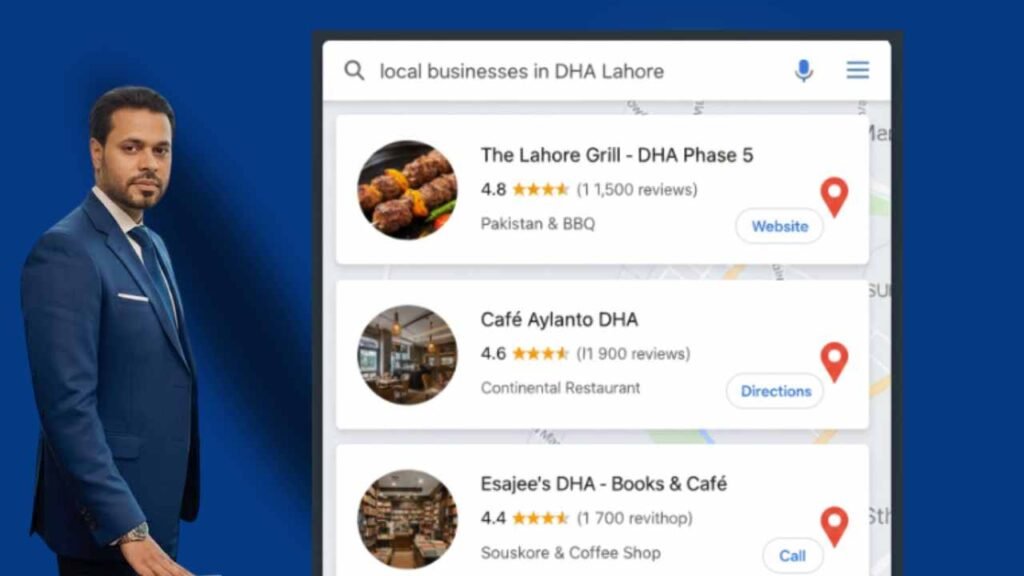
Open Google right now and search for any service in your area — “dentist near DHA Phase 5,” “best restaurant Gulberg,” “property agent Johar Town.” Before the regular website listings even appear, Google shows you a map with three businesses pinned on it, followed by their names, ratings, phone numbers, and directions.
That box — known as the Google Maps Pack or local pack — receives between 60 and 70 percent of all clicks for local search queries. The businesses listed in those three positions don’t just get more visibility. They get more calls, more footfall, more direction requests, and more revenue than every other business below them combined.
The question isn’t whether you want to be there. Every business owner in Lahore wants to be there. The question is: what does it actually take to get into those three positions — and stay there — in one of Pakistan’s most competitive commercial cities?
This is not a beginner’s guide to local SEO. If you want to understand why your Lahore business needs an SEO expert in the first place, or how the broader local SEO landscape in Lahore works, those foundations are covered elsewhere. This article goes deeper — into the specific mechanics, signals, and strategic decisions that determine who holds those Map Pack positions in Lahore’s most competitive neighbourhoods and industries.
What the Google Maps Pack Actually Is (and Why It Behaves Differently From Organic Search)
The Google Maps Pack is a distinct ranking system from organic search. This distinction matters enormously — and it’s one that most generic digital marketing advice completely glosses over.
Organic search rankings are primarily driven by: domain authority, backlink profiles, on-page content quality, and technical website health. These signals take months to build and years to compound.
The Maps Pack operates on a different scoring model. Google evaluates local businesses across three core pillars:
Relevance — How closely does this business match what the user searched for? Does Google’s understanding of your business category, services, and content align with the search query?
Distance — How close is this business to the searcher’s location (or the location specified in the search)? This is the proximity signal, and it’s why a clinic in DHA Phase 6 will naturally rank for searches made in DHA before it ranks for searches made in Johar Town.
Prominence — How well-known and trusted is this business? This includes review volume and recency, ratings, citation consistency, backlinks pointing to the business, and behavioural signals like how often users click “Get Directions” or “Call.”
The critical insight is this: a business with a mediocre website but an excellently managed local presence can outrank a technically superior website in the Maps Pack. Conversely, a beautifully designed, high-ranking organic website can be invisible in the local pack if its local signals are weak.
These are two different competitions — and most Lahore businesses are only fighting in one of them.
Why Lahore’s Maps Pack Is More Contested Than Most Business Owners Realise
With over 46,000 registered businesses across the city according to the Lahore Chamber of Commerce and Industry (LCCI), and with mobile internet penetration in Punjab accelerating rapidly, Lahore’s local search environment in 2026 is genuinely competitive — and that competition looks very different depending on which commercial zone your business operates in.
DHA and Defence: Arguably the most contested local search territory in Lahore. High consumer spending power, high mobile search volume, and a dense concentration of businesses in categories like healthcare, hospitality, education, and real estate. The Maps Pack here is almost universally occupied by businesses with 50+ reviews, fully optimised profiles, and sustained local authority.
Gulberg and MM Alam Road: Corporate and professional services dominate. B2B search behaviour is more prevalent — decision-makers searching for consultancies, agencies, legal firms, and financial advisors. Maps Pack here rewards businesses with professional E-E-A-T signals: credentials, detailed service listings, structured data, and strong review sentiment around expertise.
Johar Town and surrounding areas: Home to Arfa Software Technology Park and a dense cluster of technology companies registered with P@SHA (Pakistan Software Houses Association). IT services, software development, and digital agencies compete fiercely for local and near-local search visibility. The Maps Pack here is surprisingly winnable for newer businesses that execute local SEO correctly from day one, because many established tech companies neglect their Google Business Profiles entirely.
Bahria Town, Wapda Town, and newer residential zones: Rapidly expanding residential catchments with high “near me” search volume and relatively less Maps Pack competition than central commercial zones. For service businesses in categories like home maintenance, education, healthcare, and retail, these areas represent genuine first-mover opportunity in 2025.
Model Town, Shadman, and Cantt: Mixed residential-commercial zones where local intent queries dominate. Law firms, clinics, tutoring centres, and local retail compete for a highly engaged local audience. Citation consistency and review velocity are particularly decisive here because competitive differentiation is often narrow.
Understanding which zone your business operates in — and what the Maps Pack competition looks like specifically in that zone — is step one of any serious local SEO engagement.
The 5 Pillars of Maps Pack Dominance in Lahore
Every Maps Pack ranking outcome in Lahore can be traced back to performance across five technical and strategic pillars. Weakness in any single pillar creates a ceiling on how far your local rankings can climb.
Pillar 1: Google Business Profile Architecture
Your Google Business Profile (GBP) is the primary data source Google uses to evaluate and rank your business in the local pack. Most Lahore businesses treat it as a registration form — something you fill in once and forget. The businesses holding Maps Pack positions treat it as a living asset that requires continuous strategic management.
What a properly architected GBP looks like:
- Business name: Exactly as it appears in your legal registration — no keyword stuffing, no location modifiers that aren’t part of your actual name
- Primary category: The single most important selection you make. Google uses your primary category to determine which searches you’re eligible to appear for. Choosing “Dental Clinic” when you should be “Cosmetic Dentist” or “Orthodontist” leaves entire search segments invisible to you
- Secondary categories: Google allows multiple categories, and each one is an additional Maps Pack eligibility signal. A physiotherapy clinic that also offers sports massage and rehabilitation should have all three categories listed
- Service listings: Google’s service items are dramatically underutilised by Lahore businesses. Every service you list is an additional keyword signal. A clinic listing 5 services when they offer 25 is leaving 20 ranking signals unused
- Business description: 750 characters to communicate your core offering, geographic coverage, and differentiating factors — in natural language that includes your most important local keywords without stuffing
- Photos: Geo-tagged, regularly updated images. Google weighs photo recency and volume as engagement signals. A profile with 4 photos uploaded three years ago signals dormancy
- Google Posts: Weekly posts using local keywords and service-specific language. Not used for promotional fluff — used as active content signals to Google
Pillar 2: NAP Consistency and Citation Architecture
NAP stands for Name, Address, Phone number — and the consistency of this data across every online mention of your business is one of the foundational local trust signals Google uses.
For Lahore businesses, NAP inconsistency is endemic. The most common failure patterns:
- Business listed as “Ahmed & Sons Dental Care” in one directory and “Ahmed & Sons Dental” in another
- Phone number with +92 prefix in one place and 03XX format in another
- Address written as “Plot 5, Commercial Broadway, DHA Phase 6” in one citation and “5 Commercial Broadway DHA” in another
To Google, these inconsistencies suggest that the business information may not be reliable — which suppresses local authority scoring.
A proper citation architecture for a Lahore business covers:
- Google Business Profile (primary)
- Pakistan-specific business directories
- Industry-relevant directories (healthcare directories for clinics, property portals for real estate agents)
- Social media profiles (Facebook, LinkedIn, Instagram — all with consistent NAP)
- Chamber of Commerce listings (LCCI membership directories)
- Local news and media mentions
Every citation must use identical NAP formatting. The process of auditing and correcting existing citations — called citation cleanup — is often one of the highest-impact activities in the first 30 days of a local SEO engagement.
Pillar 3: Review Velocity and Sentiment Strategy
Reviews are both a direct ranking signal and a conversion signal — they affect whether you appear in the Maps Pack, and they affect whether someone calls you once they see you there.
The two metrics that matter most are review velocity (how consistently new reviews are arriving) and review recency (how recent your most recent reviews are).
A business with 200 reviews, most of them from 2022, will generally be outranked in the Maps Pack by a business with 60 reviews that has been receiving 4–6 new reviews consistently every month throughout 2026. Google interprets consistent review velocity as a signal of an actively operating, engaged business.
A systematic review generation process for a Lahore business includes:
- Post-service review request workflows (SMS, WhatsApp, email follow-up — timed appropriately for your service type)
- In-premises QR codes linking directly to the GBP review form
- Team training on when and how to ask for reviews (the right timing dramatically improves conversion rate from request to review)
- Review response strategy — responding to every review, positive and negative, with professional and contextually relevant replies
The review response element is particularly important for Pakistani businesses because negative review handling is frequently poor. A business that responds thoughtfully to a critical review signals professionalism and engagement — which is itself a trust signal to both Google and potential customers reading those reviews.
Pillar 4: Local Content Authority
The Maps Pack does not operate in isolation from your website. Google evaluates the relationship between your GBP and your website as part of its prominence assessment. A business whose website has strong, locally-relevant content — pages that mention the specific neighbourhoods it serves, service-specific pages with local context, and blog content addressing locally relevant topics — receives a stronger prominence signal than one whose website is a thin, generic five-page brochure.
For Lahore businesses, local content authority means creating pages and content that:
- Name and address the specific commercial zones your business serves (DHA, Gulberg, Bahria Town, Johar Town, etc.)
- Use the same language patterns that Lahori customers use when searching — including the Urdu-English hybrid vocabulary of Pakistani search behaviour
- Address locally-relevant questions that your customers actually ask
- Reference real Lahore context: local landmarks, area-specific pricing norms, Pakistan-specific regulatory considerations in your industry
This is the content layer that generic SEO agencies — those operating from outside Lahore or without genuine market knowledge — consistently fail to deliver.
Pillar 5: Behavioural Signals and Profile Engagement
Google increasingly uses behavioural signals to validate its ranking decisions. For the Maps Pack, the most relevant behavioural metrics are:
- Click-through rate from search results: How often do users click on your Maps Pack listing when they see it?
- Direction requests: How many users request directions to your location?
- Phone calls via GBP: How many users call directly from your Google Business Profile?
- Website visits from GBP: How many users click through to your website from your profile?
These signals create a feedback loop: better-optimised profiles generate higher engagement, which signals to Google that the listing is relevant and useful, which improves ranking, which generates more impressions and further engagement.
Profile completeness directly affects engagement rate. A profile with high-quality photos, clear service listings, accurate hours, and active posts consistently outperforms a sparse or outdated profile in click-through rates — even when both appear in similar positions.
What a Local SEO Expert in Lahore Actually Manages Day-to-Day
When a Lahore business engages a specialist in local SEO services, the scope of work goes well beyond setting up a Google Business Profile. Here is what an active, properly managed local SEO engagement actually looks like on a monthly basis:
Technical monitoring: Regular checks for GBP suspensions, ownership issues, duplicate listings, and category drift (Google sometimes changes your business categories automatically — this needs catching quickly).
Review monitoring and response: Tracking incoming reviews across all platforms, drafting and posting responses, flagging inappropriate reviews for removal, and feeding the review generation pipeline.
Content publishing: Regular Google Posts, new photo uploads, updated service information, seasonal adjustments to business description language.
Citation management: Monitoring for new inconsistencies, correcting any that appear, building new citations in relevant directories as they become available.
Competitive tracking: Monitoring the Maps Pack positions of your direct competitors in your specific zone and category — tracking when they gain or lose reviews, change their GBP content, or receive new backlinks.
Reporting and strategy adaptation: Monthly analysis of GBP Insights data (search queries driving your profile views, actions taken on your profile, photo view counts) and adaptation of strategy based on what the data shows.
This is not a one-time setup task. It is an ongoing strategic operation — which is exactly why businesses attempting to manage local SEO themselves alongside running a business rarely see competitive Maps Pack performance.
Strategic Scenario: A Johar Town Clinic Enters a Dominated Local Pack
To make the pillar framework concrete, consider a realistic scenario from Lahore’s healthcare sector.
A new physiotherapy clinic opens in Johar Town in mid-2024. Three established clinics already hold the Maps Pack positions for “physiotherapist Johar Town Lahore.” The new clinic has a clean website but no local presence, no reviews, and a newly claimed but unconfigured GBP.
Competitive audit findings:
- All three ranking clinics have between 35 and 80 reviews, with the top-ranked clinic averaging 4.8 stars
- None of them list “sports injury rehabilitation,” “post-surgical physiotherapy,” or “dry needling” as service items on their GBPs — despite offering similar services
- None have Google Posts published in the past 90 days
- Two of the three have NAP inconsistencies across their citation profiles
- None have a local-content-optimised website page specifically targeting Johar Town + physiotherapy
What a structured local SEO strategy builds in 90 days:
- A fully configured GBP with 6 categories, 22 service listings (covering every specialisation), 400-word description with natural local keyword integration, and 18 geo-tagged photos
- NAP verified and consistent across 28 citation sources
- A review generation process that brings the clinic from 0 to 26 verified reviews within 60 days
- A dedicated website page targeting “physiotherapy clinic Johar Town” with 800 words of locally relevant content, clinic-specific schema markup, and internal links to relevant service pages
- Weekly Google Posts through the 90-day window, each referencing a specific service and the Johar Town/Lahore context
The Maps Pack outcome: Within this timeframe, the clinic begins appearing in the Maps Pack for longer-tail queries such as “sports physiotherapist near Johar Town” and “dry needling Lahore.” Core competitive terms require continued momentum — but the foundational signals that determine long-term pack positioning have been correctly established. The three incumbent clinics, two of which have citation inconsistencies and inactive GBPs, have a narrower competitive moat than they realise.
This is the structural advantage that proactive local SEO engineering delivers: you build the right signals while competitors coast on their legacy position — and eventually, the gap closes.
The Local SEO Expert Advantage: What 18 Years of Pakistan Market Intelligence Provides
Generic local SEO playbooks exist everywhere. What they cannot replicate is deep, accumulated market knowledge specific to a city, its commercial zones, its industries, and its search behaviour patterns.
Junaid Tariq’s work across 18+ years — spanning PTCL, national retail brands, healthcare networks, and hundreds of local Pakistani businesses — provides a specific kind of strategic advantage that experience in a different market simply cannot substitute:
- Understanding of which Lahore business categories have structurally weak Maps Pack competition (and which are saturated)
- Knowledge of Pakistan-specific citation sources that carry genuine local authority weight
- Familiarity with the Urdu-English hybrid search vocabulary that affects local keyword strategy
- Experience with the specific Google Business Profile suspension patterns that affect Pakistani businesses (a non-trivial issue that catches many businesses by surprise)
- Understanding of how seasonal events — Eid, Ramadan, university admissions season, wedding season — shift local search behaviour in specific Lahore commercial categories
This market intelligence, combined with technical local SEO execution, is what the verified results portfolio reflects across industries and locations.
A Quick Self-Assessment: Where Does Your Lahore Business Stand in the Maps Pack?
Use this checklist to evaluate your current local SEO position:
Signal |
Weak |
Developing |
Strong |
|---|---|---|---|
GBP fully verified and complete |
Unclaimed or incomplete |
Basic info only |
All fields complete, regularly updated |
Primary and secondary categories |
Only one category |
2–3 categories |
5+ relevant categories selected |
Service listings |
None or minimal |
5–10 services |
20+ services with descriptions |
Review count and recency |
Under 15 reviews or outdated |
15–40 reviews |
40+ reviews, consistently updated |
Review response rate |
No responses |
Sporadic |
100% responded within 48 hours |
NAP consistency |
Inconsistent across directories |
Partially consistent |
Fully consistent across 20+ sources |
Google Posts activity |
No posts or over 90 days old |
Occasional |
Weekly, keyword-relevant posts |
Local content on website |
No location-specific pages |
Generic area mentions |
Dedicated optimised local pages |
Photo count and recency |
Under 10 photos |
10–20 photos |
20+ photos, updated regularly |
GBP Insights review |
Never checked |
Occasional |
Monthly strategic review |
If three or more of your signals fall in the “Weak” column, you are not competing in the Maps Pack — you’re occupying space in it. That’s a different thing, and a missed opportunity that compounds every month.
Frequently Asked Questions
What is the Google Maps Pack and why does it matter for Lahore businesses? The Google Maps Pack is the set of three local businesses shown at the top of Google search results for location-based queries — displayed with a map, star ratings, phone numbers, and directions. For local Lahore businesses, these three positions capture the majority of clicks and calls for any given service query, making Maps Pack visibility significantly more valuable than organic rankings for businesses serving local customers.
How long does it take to rank in the Google Maps Pack in Lahore? For lower-competition queries in neighbourhoods like Wapda Town, Allama Iqbal Town, or Bahria Town, initial Maps Pack appearance can happen within 30–60 days of a properly executed strategy. In more contested zones like DHA or Gulberg, and in competitive categories like healthcare or real estate, meaningful Maps Pack positioning typically requires 3–5 months of consistent optimisation across all five local SEO pillars.
What is the difference between the Maps Pack and regular Google organic rankings? Organic rankings are driven primarily by website domain authority, content quality, backlink profiles, and technical SEO. The Maps Pack uses a separate scoring model based on Relevance (does your business match the search?), Distance (proximity to the searcher), and Prominence (how well-known and trusted is your business based on reviews, citations, and engagement signals). A business can rank in the Maps Pack without strong organic rankings, and vice versa — they require different, though complementary, strategies.
Why is my Lahore business showing in Google Maps but not in the Maps Pack at the top of search results? Appearing on Google Maps and appearing in the Maps Pack (the top 3 in search results) are different things. Being visible on Google Maps means your business is indexed. Appearing in the Maps Pack for search queries requires your business to rank in the top 3 based on relevance, proximity, and prominence signals. The most common reasons a business doesn’t reach the top 3 include: incomplete GBP, insufficient or infrequent reviews, NAP inconsistencies, weak local content, or simply being outperformed on prominence signals by competitors.
How important are Google reviews for Maps Pack ranking in Lahore? Reviews are one of the most direct and measurable prominence signals for Maps Pack ranking. Both the quantity and recency of reviews matter — a business with consistent monthly review activity will typically outrank one with more total reviews that stopped receiving them months ago. Review sentiment also matters: a 4.9 average from 80 reviews signals significantly higher trust than a 3.8 from 200 reviews. For Lahore businesses, building a systematic review generation process is one of the highest-ROI activities in local SEO.
Can a new business in Lahore compete with established businesses in the Maps Pack? Yes — and this is one of the most important realities about local SEO. Many established Lahore businesses have held Maps Pack positions for years through legacy and inactivity rather than active optimisation. Their GBPs are outdated, their review flow has stagnated, and their citation profiles have inconsistencies. A new business that executes local SEO correctly from day one can build stronger current signals than an established competitor who is coasting on historical prominence. It takes 90–180 days to become genuinely competitive, but the window is real.
What is NAP consistency and why does it affect my Lahore business’s Maps Pack ranking? NAP stands for Name, Address, Phone number — the core identity data of your business as it appears across the internet. Google cross-references your NAP across all directories, social profiles, and websites to build confidence in your business’s legitimacy and location. When this data is inconsistent — different phone formats, abbreviated address variations, spelling differences in your business name — Google’s confidence in your local authority decreases, which suppresses Maps Pack ranking. NAP cleanup and consistent citation architecture are foundational to any serious local SEO campaign in Lahore.
Should I focus on the Maps Pack or organic rankings first? For most Lahore businesses serving local customers, Maps Pack visibility should be the first priority because it delivers the fastest return in the form of calls and direction requests from high-intent searchers. Organic rankings build brand authority and capture a broader informational audience, which eventually feeds the conversion pipeline. The most effective strategy runs both in parallel — but if budget or bandwidth requires prioritisation, local Maps Pack optimisation produces faster measurable business outcomes for local service businesses in Lahore.
How do Google Posts on my Business Profile affect my Maps Pack ranking? Google Posts don’t directly spike Maps Pack rankings in the way that reviews or citations do, but they contribute to the engagement and activity signals that Google weighs under the Prominence pillar. A profile with regular, relevant Posts demonstrates that the business is active and engaged — which correlates with higher click-through rates, which creates a positive feedback loop for ranking. Posts also appear directly in Maps Pack results for branded searches, meaning they have a direct impact on conversion rates even when their ranking effect is indirect.
What does a local SEO expert in Lahore charge, and is it worth it? Local SEO retainers for Lahore businesses typically start from Rs. 25,000–40,000 per month for single-location businesses in moderately competitive categories. More contested industries or multi-location businesses require proportionally higher investment. The value calculation is straightforward: if Maps Pack visibility generates an additional 15–30 qualified enquiries per month, and your average client value is Rs. 20,000–50,000, the return on a Rs. 35,000 SEO investment is clear within the first few months of ranking. The question is not whether it’s worth it — it’s whether you can afford the compounding cost of competitors claiming that visibility while you don’t.
Your Maps Pack Position Is Being Decided Right Now
Every day that passes in Lahore’s local search market is a day that your competitors’ review velocity is building, their citation profiles are expanding, and their GBP engagement signals are accumulating. The Maps Pack is not a static leaderboard — it is a constantly shifting competition where the businesses investing in local authority today will hold the positions that generate leads tomorrow.
The difference between the business in position 1 of the Maps Pack and the one in position 4 is often not quality of service. It is quality of local SEO execution — the technical signals, the strategic consistency, and the market intelligence to know what Lahore’s search environment specifically rewards.
If you’re ready to understand exactly where your business stands in the Maps Pack — what your competitors are doing better, what gaps exist in your local presence, and what a realistic path to the top 3 looks like for your area and category — the starting point is a proper local audit.
Request Your Free Local SEO Audit →
No generic reports. No automated tools. A real assessment of your specific Maps Pack position in your specific Lahore neighbourhood, from someone who has been navigating this market for 18 years.
Junaid Tariq is a Lahore-based SEO strategist with 18+ years of experience, 100,000+ keywords ranked, and a portfolio spanning PTCL, national retail brands, and hundreds of local Pakistani businesses. He holds certifications from Google, Harvard, and Facebook, and is a national award winner in digital marketing in Pakistan. See his verified results and client reviews.